Donate


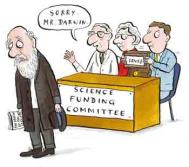
IN THE NINETEENTH century, Charles Darwin was just one of the many independent researchers who, not reliant on grants or constrained by the conservative pressures of anonymous peer review, did stunningly original work. That kind of freedom and independence has become almost non-existent. These days, the kinds of research that can happen are determined by science funding committees, not by the human imagination.
What is more, the power in those committees is increasingly concentrated in the hands of politically adept older scientists, government officials and representatives of big business. Young graduates on short-term contracts constitute a growing scientific underclass. In the US, the proportion of biomedical grants awarded to investigators under thirty-five plummeted from twenty-three per cent in 1980 to just four per cent today.
This is bad news. As science becomes more and more about climbing corporate career ladders, and less and less about soaring journeys of the mind, so the public's distrust of scientists and their work seems to grow.
In 2000, a government-sponsored survey in Britain on public attitudes to science revealed that most people believed that "science is driven by business - at the end of the day, it's all about money." Over three-quarters of those surveyed agreed that "it is important to have some scientists who are not linked to business." More than two-thirds thought "scientists should listen more to what ordinary people think."
Worried about this public alienation, the British government now says it wants to engage the wider public in a "dialogue between science, policymakers and the public". In official circles, the fashion has shifted from a 'deficit' model of the public understanding of science - which sees simple factual education as the key - to an 'engagement' model of science and society.
This may be helpful, but it is not enough. There needs to be a different way of funding research. I suggest an experiment: spend one per cent of the science budget on research of real interest to laypeople, who pay for all publicly financed research through taxes. Then science would literally become more popular.
WHAT QUESTIONS WOULD be of public interest? Why not ask? Organisations such as charities, schools, local authorities, trades unions, environmental groups and gardening associations could be invited to make suggestions. Within each organisation, the very possibility of proposing research would probably trigger far-ranging discussions, and would lead to a sense of involvement in many sections of the population.
To avoid the one per cent fund being taken over by the science establishment, it would need to be administered by a board largely composed of non-scientists, as in many research charities. Funding would be restricted to areas not already covered by the other ninety-nine per cent of the science budget.
This system could be treated as an experiment, and tried out for, say, five years. If it had no useful effects, it could be discontinued. If it led to good research, greater public trust in science and increased interest among young students, the percentage allocated to this fund could be increased.
The National Center for Complementary and Alternative Medicine (NCCAM) established by the US Congress in 1998 sets a precedent. Complementary and alternative medicine are of great interest to millions of Americans, and NCCAM's current annual budget is $100 million. But before NCCAM's predecessor, the Office of Alternative Medicine, was set up by Congress in 1992, research in these fields was receiving practically no support through established agencies. This is still the case in most countries, including Britain.
This new venture, open to democratic input and public participation, would involve no additional expenditure, but would have a big effect on people's involvement in research and innovation, and help break down the depressing alienation many people feel from science. It would enable scientists themselves to think more freely. And it would be more fun. o
For further information visit www.sheldrake.org.