Donate


Resurgence & Ecologist magazine The Moral Economy
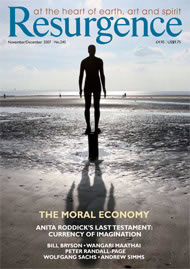
Buy a copy of this issue
Become a member and receive 6 issues a year
Contents
Key
Free for all to view
Free for members to view
Not available
Tribute to Anita Roddick
Beauty and Imagination • Lorna Howarth
Issue 245 of Resurgence is dedicated to Anita Roddick, who died on 10th September 2007.
Frontline
A Drop to Drink • Kate Eshelby
Citizen action for clean, safe water in Ghana.
Keeping it Local • Paul Kingsnorth
Using community currencies to sideline corporate monopolies.
Fascinating Fungi • Nicola Peel
The Amazon Mycoremediation Project is using fungi to clean up contaminated soil in Ecuador.
Energy Lessons • Paul Kingsnorth
Two British primary schools are leading the way with their eco-clubs and eco-councils and have reached the finals of the Ashden Awards.
Carbon Diet • Paul Kingsnorth
An accurate way of calculating your daily ecological footprint.
Green Marketing • Andy Hobsbawn
Green Thing is turning sustainable behaviour from a chore into a pleasure.
Waste Not? • Paul Kingsnorth
BIOTECH India has reached the finals of the Ashden Awards for its small-scale plants which turn food waste into biogas.
Keynotes
Ecocide • Peter Bunyard
If we are truly concerned about climate change, then protecting rainforests and other ecosystems around the world is of paramount importance.
The Tyranny of Urgency • Carlo Petrini
Eco-gastronomy can help to restore the traditional knowledge regarding taste, nutrition, biodiversity and agriculture that we have lost in our rush towards development at any cost.
A Cherished Land • Bill Bryson
The new President of the Campaign to Protect Rural England pledges to safeguard our natural heritage.
Nonviolence • Jack Santa Barbara
Recognising the core value of nonviolence could strengthen the effectiveness of non-governmental organisations.
The Moral Economy
Moral Compass • Andrew Simms
What is the economy for, and how do we know if it is succeeding?
Currency of the Imagination • Anita Roddick
In order to restore beauty in our economy, our cities and our lives, we need a new currency.
Poverty and Empowerment • Wangari Maathai
The founder of the Green Belt Movement shows how justice and sustainability are prerequisites for peace.
Economics of Happiness • Helena Norberg-Hodge
Community and a deep connection with Nature are key ingredients for health and wellbeing.
Earth I Love • Satish Kumar
Nature is the real source of our wealth.
Natural Economy • Miguel Mendonça
Germany is addressing climate change by working with Nature.
DEAR SECRETARY OF STATE • Anonymous Reader
Undercurrents
Lower Carbon, Higher Quality • Pooran Desai
Eco-towns and zero-carbon homes will work only within the context of a low-carbon lifestyle.
Globo-Petro-Cops • Tony Clarke
Oil is the cause of global wars as well as global warming. We need to free ourselves from oil dependency to save the Earth and save ourselves.
The Arts
Poetry • Fiona Sampson
The editor of Poetry Review introduces new work by three influential eco-poets: Pascale Petit, John Burnside and David Harsent.
Pattern and Metaphor • Lorna Howarth
Seed, Peter Randall-Page's iconic sculpture at the Eden Project, embodies his interest in pattern, collaborative working and the juxtaposition between inner and outer form.
Marbling • Sandy Brown
Grizel Luttman-Johnson and Dorothy Feibleman use marbling in very different ways.
Regulars
Slow Travel - JOURNEYING AFAR • Barbara Haddrill
It is possible to travel from Europe to Australia without flying - an adventure that values the journey as much as the destination.
Sensible Solutions - BIOFUELS • Oliver Tickell
Palm-oil production is a major cause of deforestation in the Far East. We need to halt the headlong rush towards biofuels at any cost.
Turning Point - ARTISAN ECONOMY • Carole Bamford
Protecting and nurturing Nature and human relationships: one person's moment of epiphany, and how she converted two farms to organic methods.
Gardening - LIVING LIBRARY • Brigitte Norland
Martin Hughes-Jones and Susan Proud have been working with the elements to create a magical garden on their land in Devon.
Letters to the Editors
Reviews
In My Own Words: Fair Future • Wolfgang Sachs
Review of It will not be possible to develop successful economics in the 21st century based on the 19th-century model. There will be no equity without ecology.
Monopolising Advantage • David Boyle
Review of Tescopoly: How One Shop Came Out on Top and Why it Matters by Andrew Simms
Lessons from the Past • Dan Grace
Review of A New Green History of the World by Clive Ponting
Agriculture of Nonsense • Colin Tudge
Review of A History of World Agriculture by Marcel Mazoyer and Laurence Roudart
Under Stress • Lorna Howarth
Review of The Upside of Down by Thomas Homer-Dixon
Whole Planet Re-Think • Horatio Morpurgo
Review of Earthy Realism (ed.) Mary Midgley
Giving Nature its Due • Edmund O'Sullivan
Review of Nature's Due by Brian Goodwin
Thinking Differently • Mary Tasker
Review of Visionaries of the 20th Century (eds) Satish Kumar and Freddie Whitefield
Food at its Fullest • Peter Kindersley
Review of Slow Food Nation by Carlo Petrini
We are Architects of an Empty House • Peter Abbs
Review of North Flight by Lynne Wycherley
Web Exclusives
Article - TRANSITION TIME • Richard Heinberg
From the Age of Excess to the Era of Moderation.
Article - WORKING WITH ANGER • Thubten Chodron
Anger is a passing cloud on the pure nature of mind.
Review - A VICTORIAN HISTORIAN • Diana Schumacher
Review of Froude Today by John Coleman