Donate


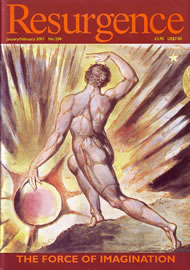
Resurgence & Ecologist magazine The force of imagination
Buy a copy of this issue
Become a member and receive 6 issues a year
Contents
Key
Free for all to view
Free for members to view
Not available
Welcome
Welcome • Satish Kumar
Feature articles
WILLIAM BLAKE Prophet of Imagination • Kathleen Raine
An introduction to the renowned poet, painter, visionary and mystic.
EARTH COMMUNITY • Thomas Berry
The human economy is a subsystem of the Earth economy.
FORCE FOR CHANGE • Augusto Boal
To "act" is to perform and to take action for social change.
EXPLORING GAIA • Stephan Harding
Gaia theory extends natural selection to include the evolution of organisms and their physical environment.
GREEN BUDDHISM • Maurice Ash
A sense of wholeness demands appropriateness of scale.
FREE LUNCHES, YES: FREE MARKETS, NO • James Robertson
Fairer sharing of the value of common resources is practical politics, not just a utopian dream.
FRIENDS OF CITIES • Daniel Mittler
To love nature we must not abandon cities.
Education
EDUCATING ON A HUMAN SCALE • Fiona Carnie
Integrating ecology, community and holistic values.
TRUE LEARNING • Jenny Brain
Schools where art and environment form the basis of early childhood education.
A TALE OF TWO SCHOOLS • Caroline Walker
All education is environmental education.
AN EARTH ACADEMY • David Nicholson-Lord
Schumacher College celebrates ten years of environmental education.
Protest
SOLIDARITY IS IN THE AIR • Margaret Jones
Resistance is as transnational as capital.
The Arts
A PARADE OF BEAUTY • Donna Gold
John Wilde makes you love the wormhole in a leaf.
SCULPTOR OF THE HUMAN SPIRIT • William Varley
Nicolaus Widerberg's sculptures have empirical and intuitive qualities.
Frontline
FARMERS' REVOLT - LAURA COPPO • David Rose
Supreme court stops intensive shrimp farming.
GREEN LAWYER
Getting tough on polluters.
Meditation
MASTERING THE MIND • S. N. Goenka
Vipassana meditation is a way of being at peace with oneself and with the world.
Regulars
Touchstone • Colin Hodgetts
Letter from America • Jay Walljasper
Poetry • Dana Gioia
Recipes - OATS • Dana Spowers
Reviews
THE FRIEND OF THE EARTH • Peter Quince
Review of Let the Mountains Talk
PASSION FOR PEACE • Mary Tasker
Review of Cultures of Peace
SAINT JANE OF THE CHIMPS • John Elkington
Review of Reason for Hope
AGEING IS NO ACCIDENT • Theodore Roszak
Review of The Force of Character
WHEEL AND ARROW • Dorothy Schwartz
Review of Pip, Pip: a Sideways Look at Time
A TOWERING THINKER • Kirkpatrick Sale
Review of Sidewalk Critic
ELUCIDATING SOUL • Gay Watson
Review of Integral Psychology
BEAUTIFUL EARTH • Julia Ponsonby
Review of All the Marvelous Earth
SACRED PLACES • John Lane
Review of The Spirit of Asia
COMPANIES RULE, OK? • James Wells-Bruges
Review of Captive State
A HEALTHY WAY OF LIFE • Suresh Rambhai
Review of Ayurveda for the Western Mind