Donate


Resurgence & Ecologist magazine You are, therefore I am
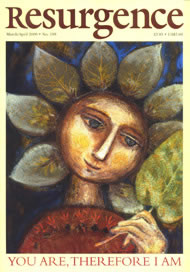
Buy a copy of this issue
Become a member and receive 6 issues a year
Contents
Key
Free for all to view
Free for members to view
Not available
Welcome
Welcome • Satish Kumar
Feature articles
A NEW SYNTHESIS • Richard Tarnas
We seem to be moving toward a more integral world-view.
ON ATONEMENT • Maurice Ash
Dualistic knowledge is inherently flawed.
EARTH FAMILY • Vandana Shiva
All and everything exist in an eternal relationship between species.
FREE NATURE • Bill Devall
Fifty per cent of the total land and water areas of the Earth should be designated wilderness areas.
GIVE PEACE A BANK • Scilla Elworthy
If peace is to be given a chance, it must be given a bank.
PUBLIC VALUES • Peter Melchett
Social and environmental issues are central to the world's economic health.
LET DARKNESS REIGN • Michael Shaw Bond
Light pollution is killing our nights.
I LOVE ROSES • Donella Meadows
There is no excuse for poisoning flowers.
LOCAL FOOD • Tracy Worcester
The production and distribution of food should be in the hands of local communities.
LOCAL TIME • Jay Griffiths
While Dome-Time dominates our minds, let us reflect on Cow-Time.
NATURE CONNECTS • Mae Anderson
New Dimensions presents a rounded view of deep ecology.
TRUSTING THE TRUST • Paul Kingsnorth
The National Trust needs to put environmental issues at the top of its agenda.
New Ideas
RESTORING THE EARTH • Alan Watson Featherstone
Let us invite the UN to declare the twenty-first century as the century of restoring the Earth.
The Arts
A WAY OF BEING • Jenny Balfour-Paul
The paintings of Jeanine de Waele.
WOOD ECONOMY • Peter Bunyard
Tino Rawnsley is a great bodger.
Frontline
NATURE SCHOOLS • Anna Adhémar
Nature is the greatest teacher in nursery schools in Scandinavia.
ART AND NATURE • Clive Adams
A new Centre is being established to integrate earth and imagination.
HUNGER IN AMERICA • Lois Robbins
A creative response to poverty
Regulars
Up the Elephant and Round the Castle • David Nicholson-Lord
The Occasional Didymus • John Moat
Good News For Gaia • Sophie Poklewski Koziell
A Sense of Place • Jamie Drummond & Geoff Mulgan
Letters to the Editors
Reviews
FILM - AGE OF MUSIC • Sandy Irvine
Review of The Buena Vista Social Club
TECHNOLOGICAL PROGRESS • Mary Tasker
Review of Techgnosis: Myth, Magic and Mysticism in the Age of Information
GREENING NEW LABOUR • Marcus Mander & Alex Evans
Review of Environmental Modernisation
CRUDE FOOD • Marian Van Eyk McCain
Review of * Reviews various books on Genetic Engineering
FOOD FACTS • Judy Jones
Review of The New Foods Guide, The Meat Business: Devouring a Hungry Planet
ANIMAL POWERS • Jordi Pigem
Review of Dogs that know when their Owners are Coming Home
PHOTOGRAPHIC VISION • John Lane
Review of Brandt: The photography
A SEA ETHIC • Mark Tredinnick
Review of A Jerk on One End
AMERICAN BOOK ROUNDUP • Kirkpatrick Sale
Review of Inequity in the Global Village Ecotourism and Sustainable Development With Good Intentions
IN CASE YOU MISSED IT • Victoria Bawtree
Review of In the Wake of the Affluent Society
DAMS OF DESTRUCTION • Giles Chitty
Review of The Cost of Living