Donate


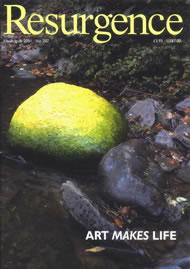
Art Makes Life
Membership Includes:
6 issues of Resurgence & Ecologist magazine a year
Access to:
• Articles online • Digital Editions • Archive issues
Inside this issue
Article is free for all to view
Welcome
Welcome • Satish Kumar
Economics
THE AGE OF ACCESS • Jeremy Rifkin
Can civilization survive with the commercial sphere as the primary mediator of human life?
VISIONARIES • Bernard Lietaer
Complementary currencies can lead us towards a more equitable future.
SOLAR SOLUTIONS • Hermann Scheer
Moving from a fossilized economy to a solar economy.
Business
CHANGE IS IN THE AIR • Jonathan Dimbleby
Sustainable development is not an option; it is the only option.
Science
PHILOSOPHER'S STONE • Peter Marshall
The wedding of alchemy and ecology.
Food
BREAD OF SORROW • Satish Kumar
The act of breadmaking connects us to our ecological roots.
Schumacher Lecture
DESIGN REVOLUTION • John Todd
We can all be designers using the natural world as our template.
Architecture
BEAUTY IS NOT A DIRTY WORD • Lord Richard Rogers
A building without beauty is not architecture; it is a construction.
The Arts
SENSUAL SIMPLICITY • Oliver Lowenstein
Andy Goldsworthy's work is entwined with the natural world.
THE ART OF GARDENS • Andrew Lawson
Gardeners are the painters and sculptors of the landscape.
WALKING AND CARVING • William Peers
Reaching the end is less important than the journey.
TREE OF LIFE • Jeremy Reed
Carole Berman's art is a triumph of poetic feeling.
ETERNITY NOW • Greg Tricker
Converging towards a doorway to freedom.
India Diary
THE TEMPLES OF DELIGHT • Satish Kumar & June Mitchell
The Jain temples at Mount Abu.
Education
PENALTIES OF SCALE • Mary Tasker
The small school movement in America.
Frontline
REACHING OUT
Swadhyaya devotees transform communities.
INCINERATOR DEFEATED
Producer responsibility taken to heart.
TB OR NOT TB?
Homoeopathy could be the answer.
ANCIENT RITUALS - NEW MEANING
A Jewish prayer group mourns for Gaia.
Regulars
The Occasional Didymus • John Moat
Voice From The South • Vandana Shiva
Cutting Edge • George Monbiot
A Sense of Place • Jim Nollman
Poetry • Andrea Hollander Budy
Perspectives
Letters to the Editors
Reviews
SUFI WISDOM • Nick Pearson
Review of The Illustrated Rumi
BUDDHIST DISCOURSE • Ian Prattis
Review of The Path of Emancipation
CLIMATE NEGOTIATIONS • James Wells-Bruges
Review of Contraction and Convergence
A VISION REVISITED • John Lane
Review of William Blake: The Complete Illuminated Books/William Blake: Chambers of Imagination
SOUL LINES • Chris Hall
Review of The Journey of Thomas the Rhymer
VOICE OF A TREE • Eileen Campbell
Review of The Story of Yew
A LITTLE GOES A LONG WAY • Richard Douthwaite
Review of The Little Earth Book
A DIFFERENT SORT OF PROGRESS • Margaret Jones
Review of Green Politics and Neo-Liberalism