Donate


Resurgence & Ecologist magazine It is a gift to be simple
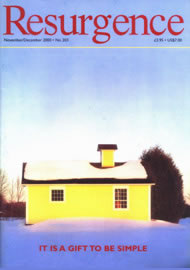
Buy a copy of this issue
Become a member and receive 6 issues a year
Contents
Key
Free for all to view
Free for members to view
Not available
Welcome
Welcome • Satish Kumar
Feature articles
A CULTURE OF SIMPLICITY • Leonard Koren
The sixteenth-century Japanese tea master refined the culture of wabi-sabi.
EPICUREAN SIMPLICITY • Stephanie Mills
How are we to live?
THE GREAT AFFAIR • Liz Medler
Thomas Merton had the knack of presenting things in simple forms.
THE FADING RAINBOW • John Feehan
Once our physical needs are satisfied what further use have we of nature?
DECLARATION OF DEPENDENCE • Satish Kumar
We depend on the Earth.
MAGIC OF THE SEA • Michael Viney
Sustainable use of inshore waters will bring security to coastal communities.
THE CHALLENGE OF OUR TIME • Fritjof Capra
A sustainable society can only be built on the foundations of ecoliteracy and ecodesign.
BEYOND THE BIG LIPS • Darrell Addison Posey
The knowledge of people of the Amazon can guide Brazil towards ecologically appropriate development.
A NOMADIC JOURNEY • Will Cretney
Oasis gardens in the Sinai desert reflect the Bedouin people's love for their land.
JOURNEY TO THE SOURCE • Freya Mathews
Three friends in Australia set off to walk to the headwaters of a little creek.
THE WORLD IS NOT FOR SALE • Donella Meadows & Hal Hamilton
We refuse to eat food from factories.
HERBICIDE, PESTICIDE ? SUICIDE • Roger Scruton
Seed merchants prosper and farmers wither.
AT THE POINT OF DEATH • Nicholas Albery
A funeral guide.
LOVING THE ENEMY • Alex Evans
How to protest with loving-kindness.
The Arts
IN THE GARDEN OF GAIA • Philip Vann
The sculptures of Giles Kent are an embodiment of simplicity and serenity.
CATCHING THE LIGHT • Emmanuel Williams
The painter, Harold Hitchcock, is enraptured by the movement of light.
Frontline
CELEBRATION • Sophie Poklewski Koziell
Resurgence marks twenty-five years of editorship.
FRIENDLY FARMING • Mahmood Futehally
Regenerating barren land in Pakistan.
CLEAN COLOUR • Bharathan & M. R. Rajagopalan
Nature gives us colour, synthetic dyes give us problems.
A RING OF GREEN • Herbert Girardet
Urban farming in Shanghai.
A VICTORY • Premila Canagaratna
Sri Lankan court blocks phosphate development.
Regulars
The Occasional Didymus • John Moat
Up the Elephant and Round the Castle • David Nicholson-Lord
Business Diary • David Boyle
Readings • Angela Zelter & Donna Rawlinson Maclean
Poetry • Grevel Lindop
A Sense of Place • Ian Christie
Recipes • Dana Spowers
Magazines & Publishers
FUTURE NATURE • David Rothenberg
An occasional magazine blending art with ecology and technology.
WOODEN BOOKS • Jay Griffiths
Books with quality of craftsmanship and delicate charm.
Reviews
SMALL IS STILL BEAUTIFUL • Kirkpatrick Sale
Review of Small is Beautiful
SCIENCE IN SERVITUDE • Mary Tasker
Review of Playing Safe: Science and the Environment
GOOD ENOUGH CITIES • Herbert Girardet
Review of Building the 21st-Century Home London, Pathways to the Future
THE RISKS WE RUN • Charles Handy
Review of Democracy at Risk
SCIENTIFIC SPIRITUALITY • Chris Clarke
Review of SQ - Spiritual Intelligence
PEOPLE AND TREES • Oliver Rathmill
Review of The Time of Trees - A Photographic Essay
PAIN AND PRAYERS • Colin Hodgetts
Review of The Pool of Memory
DANGERS OF DEVELOPMENT • Marian Van Eyk McCain
Review of The Subsistence Perspective: Beyond the Globalised Economy
ORDER AND CHAOS • Michael Shaw Bond
Review of The Blackwinged Night
PEOPLE'S CRAFT • John Lane
Review of Traditional Pottery of India The Golden Age of Irish Art
SUBLIME TRUTHS • Jordi Pigem
Review of Verses from the Center
• Kim Taplin
Review of Landscape with Portraits
• John Lane
Review of How the Whale Became
• Judy Jones
Review of The Ecology of Health
• John Lane
Review of The Tribal Arts of Africa Chokwe!
• Valerie Belsey
Review of Cutting Your Car Use