Donate



“A great thinning of the skies is underway,” declares Robert Macfarlane in the opening line of The Book of Birds. In the UK we have lost 73 million birds, and globally 50% of bird species are in decline. “Our dawns and springs are quieter; the air, emptier. An almost unimaginable abundance has been lost.” This book builds on the idea that people will not save what they do not know and love, but it does more than teach us what we are losing.
With each species, Macfarlane and his co-author Jackie Morris do not ask, “What is this bird?” but rather, “Who is this bird?” and over the course of 300 pages we become intimate friends with 49 species. All breed, passage or winter in the UK and all have significantly declined over the past 50 years and are now red or amber listed.
The book, which recently won the Wainwright Prize Book of the Year, is divided into ‘Seven Wonders’: Nest, Egg, Beak, Song, Feather, Flight and Migration. Through these categories we come to understand the miracle that makes up birds. Macfarlane invites us into their small everyday wonders. His writing soars and sings alongside them while weaving in, with the deftest of touches, the myths, stories and meanings that we humans have attached to them over time. Even the oft-perceived dry and scientific label of their Latin names is a vehicle of exploration and beautiful prose.
As you peruse the pages, you are transformed from an onlooker into an honorary bird. It is the linguistic equivalent of getting down on your hands and knees to see the world from an animal’s perspective. Hasn’t each of us dreamed of flying? Macfarlane asks, only to tumble back into bed as a “heavy-fleshed human reclaimed by gravity”. When discussing his first wonder, Nest, he points out that “humans are nesters too. We all seek places of retreat, small shelters from the world’s thunder.” He takes biological functions and explores their beauty and wonder. Something as simple as a feather is shown reverence. Eggs are held up as the scientific marvel that they are: “space station, shock absorber, safe harbour, first home”.
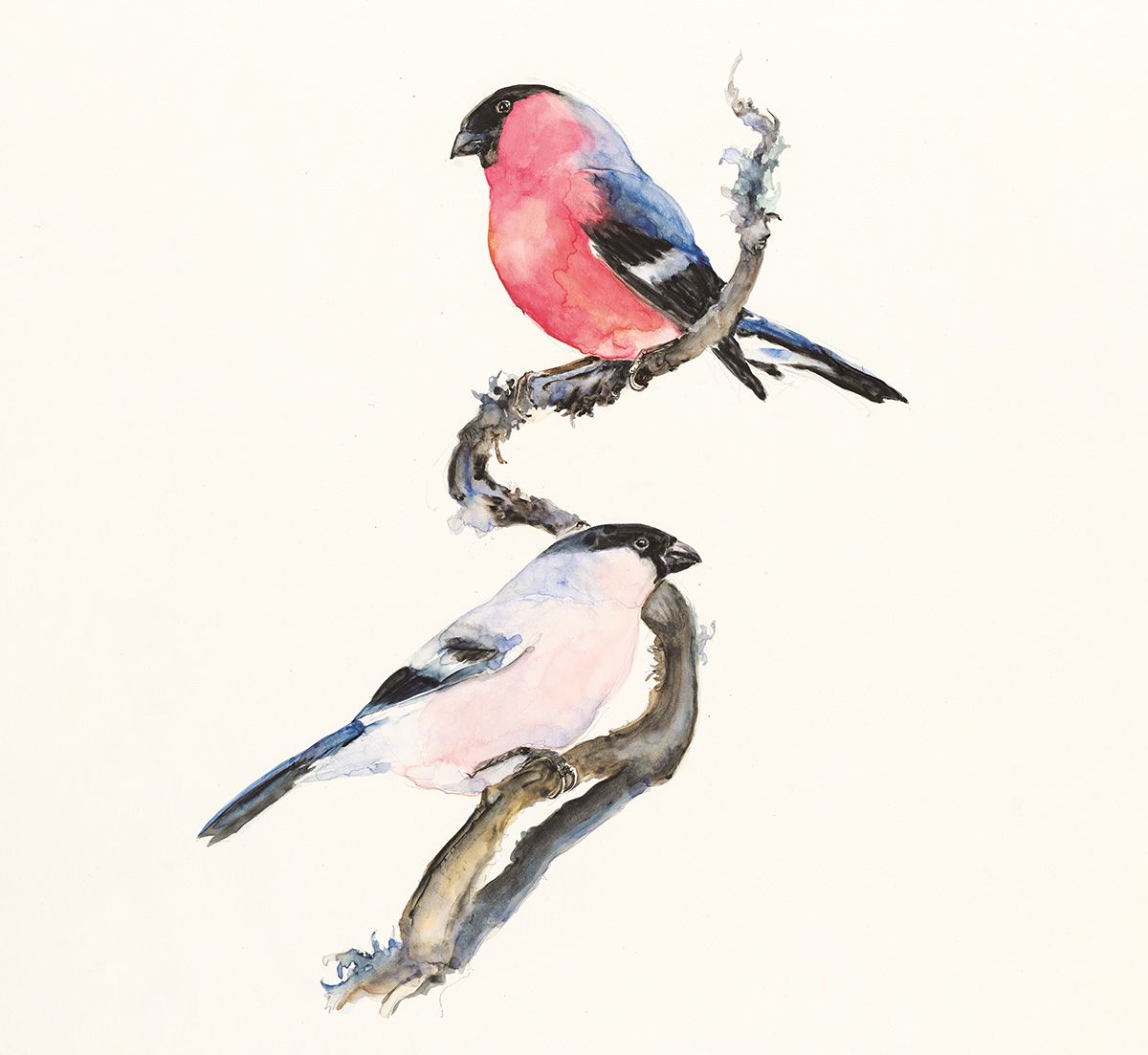
Morris’s art is, I would argue, the eighth wonder that is contained within this book, and it is brimming with energy due to the more than 300 pieces she created. Her watercolours, highlighted with gold, draw from encounters in the real world, which she uses to craft her portrait of each bird. These lived experiences mean that every image breathes, successfully capturing the emotions that the real birds evoke. The birds are not static: they fly off the page and look you right in the eye. The words and art have perfect synergy, the result of two people who have spent many years working alongside each another. The delicate description of each species is dotted with Morris’s illustrations, and then you come across a full double-page spread of the bird. You stop, look and reflect. This is the book telling you to pause for a moment, to breathe, and to understand the abundance of life that we have right at home, and what we stand to lose.
As we meet our cast of characters, from the gentle bullfinch to the savage skua, we work towards our concluding wonder: Migration. Our eyes follow the illustrated ‘V’ of migrating geese towards the lyrical prose. Macfarlane writes: “If Song is Bird’s lyric, Migration’s her epic. Each year birds write countless Odysseys and Iliads, Mahabharatas and Kalevalas.” To me, this is the key thesis of the book: every bird’s life is a marvel that is worthy of great acclaim, no less than any of our human accomplishments, and it is time that we hear more about them. This book is a love letter to birdlife, but it is also a warning. It teaches us how to identify birds, but also how to identify with them and, by the time you reach the final page, the loss of their voices feels like the loss of your own.
The Book of Birds by Robert Macfarlane and Jackie Morris. Hamish Hamilton, 2026. ISBN: 9780241404737