Donate


Ch-ch-changes
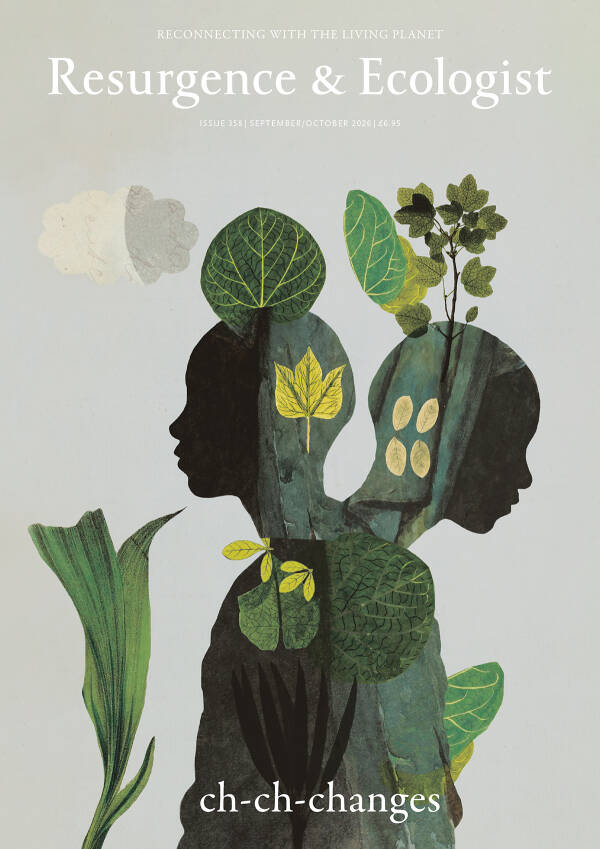
In this issue we question what change actually asks of us, and how change happens.
After a series of underperforming albums, in 1971 David Bowie stood in front of a mirror and wrote himself a way out. With the song ‘Changes’, he urged himself to “turn and face the strange” – lyrics that many biographers have read as a manifesto for the reinvention that defined his career.
It is easy to imagine change as something that begins somewhere else. It’s harder to recognise that it also asks something of us: that we loosen our grip on familiar ways of living. As writer Sophie Strand observed in the May/June issue of Resurgence & Ecologist, perhaps the strange is not some distant future, but sobriety itself – the clear-eyed recognition of how deeply our lives have become entangled in systems of extraction and separation.
To face the strange is not simply to embrace the new. It is to rediscover what has always been real: our dependence on this animate Earth, with whom we share our every breath. As we link hands with one another and the other-than-human, we begin to imagine and inhabit different ways of living and being. That is the journey this issue sets out to explore.
The pieces that follow explore how systems change, how stories shape transformation, how power can be reclaimed through citizenship and participation, and how new futures begin long before they become the norm. Together they remind us that while change is inevitable, the form it takes remains an open question – one that asks each of us, like Bowie before the mirror, to turn and face the strange.
Featured articles

The soft body of the turtle
What if humanity’s greatest strength is not competition, but cooperation? Kate Raworth and Jeremy Lent explore the conditions that allow our ‘soft bodies’ to emerge – and how new economic ideas, democratic practices and living alternatives can help us build an ecological civilisation.
Read more...
Stories for an emerging food system
Looking back on ten years of the podcast Farmerama Radio, Abby Rose reflects on how telling the stories of ecological farmers has helped reveal an emerging food system that others have gone on to join.
Read more...
The wild force of life
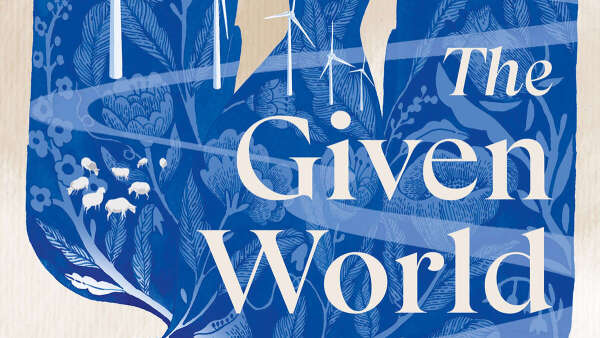
Kate Blincoe reviews Melissa Harrison’s The Given World, a new novel following the interwoven lives of twelve people in a changing English countryside. Condensed over a period of six months, it is an enduring and hopeful display of those who are part of Nature’s rhythms.
Read more...
Membership Includes:
6 issues of Resurgence & Ecologist magazine a year
Access to:
• Articles online • Digital Editions • Archive issues
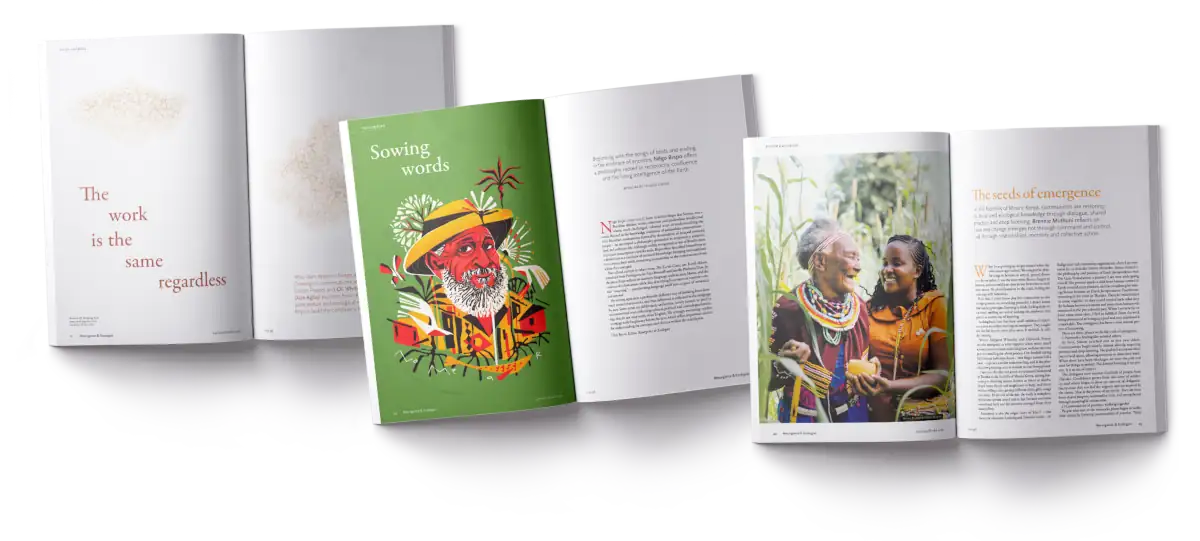
Inside this issue
Article is free for all to view
Welcome
Turn and face the strange • Dave Reeve
Discovering different ways of living and being
Regulars
Noticeboard
Highlighting stories for change
Ch-ch-changes
The work is the same regardless • Daze Aghaji
Exploring how citizenship, democratic participation and ecological responsibility can help us build the conditions for another world
The soft body of the turtle • Kate Raworth & Jeremy Lent
Examining how new economic ideas, democratic practices and living alternatives can help us build an ecological civilisation
The case for climate popularism • Rupert Read & Caroline Lucas
Why climate action becomes popular when it speaks to our lived experience
The slow read
Sowing words • Nêgo Bispo
Offering a philosophy rooted in reciprocity, confluence and the living intelligence of the Earth
Ecologist
Viewing stations • Karen Lloyd
A conversation about the future of England's Lake District grounded in ecological understanding and multispecies justice
Cultivating Consciousness • Sonam Wangchuk
Exploring Bhutan's traditions of reciprocity and ecological stewardship offer lessons for a fragmented world
Connected life
Stories for an emerging food system • Abby Rose
Reflecting on ten years of the Farmerama Radio podcast, telling the stories of land workers who have helped champion emerging food systems
After the briefing • Leah Cowan
Reporting on a local film screening of People's Emergency Briefing. How can we communicate climate breakdown and harness collective action?
Wisdom and wellbeing
The seeds of emergence • Brennie Muthoni
Communities are restoring cultural and ecological knowledge through dialogue, shared practice and collective action
From problems to solutions • Livia Giuggioli & Satish Kumar
In conversation with Satish Kumar at HUMUS, an annual gathering dedicated to regenerative agriculture and humanity
Art and culture
Becoming our proper size • Kate Fletcher
Questioning how changing the stories we tell about fashion might help us rediscover our place within the world
Away from the glitter and the turmoil • James Clarke
Revisiting Susan Fenimore Cooper's Rural Hours, a pioneering work of American Nature writing from the 19th Century
Inhale… Exhale… • Briony Hughes & Rachel Marsh
Helena Hunter transforms dried seaweed into poetry and invites us to recognise algae as an intimate, life-giving presence
Reviews
Pilgrim for peace • Nick Robins
Review of Peace is Possible
Seeding a revolution • Holly Rose
Review of Frontierlands: Britain's Survival in the Making
Bodies in Nature • Diyora Shadijanova
Review of My Body is the Meadow: Finding Freedom in the Outdoors
Feeding our Futures • Edward Davey
Review of Eat the Planet Well: How to Fix Our Toxic Food System – One Meal at a Time
Patterns of cooperation • Graham Burnett
Review of Permaculture: Practical and Radical Solutions for a World in Crisis
Liberation in forgotten roots • Francesca Rechere
Review of Finding Albion: Myth, Folklore and the Quest for a Hidden Britain
The wild force of life • Kate Blincoe
Review of The Given World