Donate


Ten years of Farmerama, ten years of sharing the voices behind regenerative farming. And I feel more certain than ever about the importance of this work.
My family started farming on 10 hectares in Chile after I went to university – it was a real baptism of fire. By the time I co-founded Farmerama, we had planted a few thousand olive trees and had many unanswered questions about how to farm ‘beyond organic’, as we called it at the time.
I had attended a few farming events in the UK and realised there were many people already farming in this way who we could learn from – it just wasn’t easy to uncover their stories. Making a podcast felt like the perfect way to ask questions while simultaneously sharing the learning with others.
From the beginning, we set out to champion farmers and landworkers already crafting a more ecological future. Every season brings new opportunities to find better ways of working with the ecosystems they tend, and we wanted to share those experiments and what they learned.
These farmers, often small-scale and working closely with natural systems, stood in stark contrast to the industrial, chemical-based farm systems that have become the norm and are often thick with mud and largely devoid of life.
It’s also important to recognise what we learned early on: most farmers, ecological or otherwise, are genuinely trying to feed people. They are far from villains in this story. Rather, their systems have been shaped by market forces and government policy over recent decades. Many find themselves locked into those systems, carrying substantial debt from infrastructure or machinery that was innovative at the time.
In one of our earliest episodes, we spoke with organic grower Ian Tolhurst about his experiments using woodchips to create biologically active, fungal-dominant compost, and even growing outdoor salads on compost heaps through the UK winter. At the time, very little was widely understood about woodchip composts, and soil science was only just cottoning on to the value of having lots of fungi in the soil – particularly for growing trees and vines.
Just over five years later, we spoke with farmer Ben Raskin, head of agroforestry at the Soil Association, about his – somewhat accidental – experiments in agroforestry with deep woodchip mulch around trees. These led to trees growing almost four times larger, insights that led him to write The Woodchip Handbook. We continue to learn more each year about the importance of fungi in soils, and often it feels as though soil scientists are learning directly from farmers who are pushing these boundaries.
As we heard so often in those early years, sharing the voices of people on land and sea, all working towards a better future, helped those farming in often isolated rural places to learn from others and feel part of a much wider movement. This collective was working to build soil health and biodiversity, to grow healthy nutritious food, to regenerate water cycles, and to nourish people both physically and emotionally.
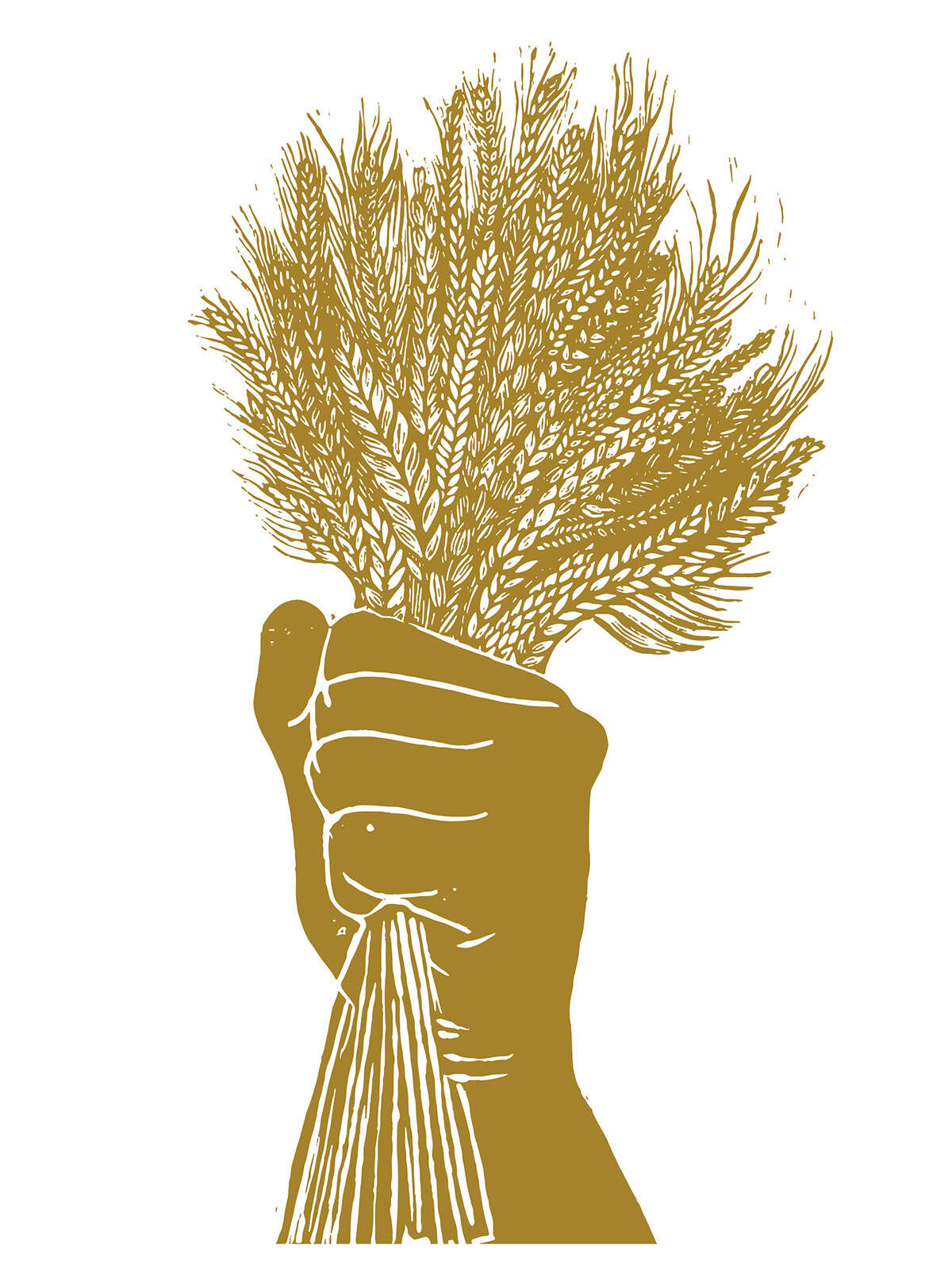
In 2019, we tried an experiment of our own. I had recently been part of an art project called A Field of Wheat, created by Anne-Marie Culhane and Ruth Levene – a truly life-changing experience. To participate, I invested £200 in a 20-acre field of wheat on farmer Peter Lundgren’s farm in Lincolnshire, along with around 40 other people. It was an eclectic group, including heritage grain experts, fertiliser specialists, an agricultural bank manager, and people like me whose only real connection with wheat was the bread I ate weekly.
We used Quaker principles to collectively discuss and make farming decisions online. I completely shocked myself by voting not to follow organic principles, but to apply nitrogen to the crop in late spring. After years of buying organic food and being incredulous that any farmer would choose synthetics, here I was doing exactly that.
I made the decision after hearing that, due to the genetics of the wheat we had sown, the likelihood of total crop failure was very high if we did not apply nitrogen. The farmer had also invested 50% of the money in the field, so he had far more to lose than the rest of us. It was a humbling experience, and there were many more moments in the decision-making process where I was taken aback – from the seeds we were legally allowed to plant and grow to the unachievable “protein” targets required to mill the wheat into flour for human consumption. At every turn, it seemed we were locked into a commodity system whether we liked it or not.
Around the same time, I met Kimberley Bell, founder of Small Food Bakery, and learned about her work using the genetically diverse wheat YQ (Yield-Quality), developed by the legendary Martin Wolfe, to bake delicious bread. It turned out that this was part of a local grains economy taking shape in the UK.
Given our proximity to this work and the understanding we had built, it made sense to create a long-form investigative podcast unearthing the constraints of the current commodity bread system, and the people in the UK powering this ‘new grains’ movement. This became our first in-depth series, Cereal, which traced how the current system came about in a logical way, but had become a trap with some illogical outcomes – just as I had experienced in A Field of Wheat.
We followed breeders, scientists, bakers, millers and farmers who are working to build a new, localised system based on knowledge-sharing and transparency, opening up a whole web of possibilities for growing and processing cereals.
Long-time organic farmer Mark Lea was brought to tears as he took a bite of a YQ loaf baked by Bell – his first ever taste of the wheat he had grown.
When Cereal came out, we were inundated with people sharing the impact listening had on their lives. Farmers got in touch asking how they could grow these population wheats (or genetically diverse varieties). Bakers around the world wrote in sharing stories of finding and building local grain systems. People seemed genuinely shocked, as I had been, about this part of the food system that we all participate in, often without realising it. Many were also feeling trapped in the commodity system and wanted the opportunity to get out and do something different.
Over this past year, we decided to dig deeper into the impact of the series through a research project and podcast we called Cereal Revisited. We were curious to understand why it struck such a chord, as well as to celebrate the listeners who took action, big or small, off the back of it.
We heard from engineer Emma Shires how Cereal helped her understand that, in order for local grains to reach bakers, we needed millers across the country who could process small batches of these wheats – so she decided to start a whole new career as a miller, and now runs a milling business providing flours to bakers in the Nottingham area. We also heard from farmers Tom and Mary Edmondson, who told us how they have shifted their business away from commodities and started milling their own grain on farm, baking bread, and setting up a farm shop supplying their local community.
So much of mainstream media focuses on the ‘hero’s journey’ – the struggles and successes of individuals – but Cereal was something different, and it had a transformational impact that the hero’s journey alone cannot achieve. There was no call to action, yet it has been incredibly powerful to see how people become curious enough to engage in their own ways – whether that be reaching out to connect to a farmer, setting up a network of like-minded bakers, returning to university for a degree in food systems, or setting off on a pilgrimage to meet the changemakers and pioneers farming differently.
This emergent system is still very small and there are many challenges ahead, from the need to permanently update UK law so that we can legally breed and trade these genetically diverse seeds to experimenting with new organisational structures because profit-focused business models tend to derail the good intentions of the emerging system.
No one person or perspective holds the answer. But by giving voice to radical ideas, experiments, failures and successes, people discover they have permission to get stuck in.
You can check out Farmerama’s new project Cereal Revisited at farmerama.co/cereal-revisited