Donate


While I was growing up, I was taught to think that Nature was pointless. I don’t mean that anyone gave me a stern lesson about not looking at, considering, or caring about Nature, about the green world around me. It was more subtle than that, and in being more subtle, harder to notice. It was in many shrugs of the shoulder, in the old fridges and burnt-out mopeds dumped in our local woods, in the lack of any conversation about it. Today, as a writer with an interest in landscape, natural history and all the ways we use that word ‘Nature’, I find this curious.
Another thing I find curious is where we think Nature is. In Britain we rarely think of Nature as urban space, where most of us live. Instead, we imagine Nature to be somewhere ‘out there’: Lake Windermere, the Mourne Mountains, Dartmoor, the South Downs. We talk of ‘getting back to’ or of ‘returning to’ Nature, which generally means getting away from where we are, which is usually urban. And then when we find Nature, we call it the best of names: Eden, Arcadia, Paradise, Utopia.
What all this suggests is that for most of us, for most of the time, we do not see where we are as being Nature. We cast ourselves as outside of the garden, banished from the beauty and majesty of our ‘mother’, Nature. But there’s another way of seeing, a way of seeing that reveals that Nature is near you, right on your doorstep. And by learning to see, hear, smell, touch and taste it, you may just reclaim something you think you might have lost.
The reason we think this way has a long history. For thousands of years in the west, we have seen ‘town’ and ‘country’ at two opposite poles, where one is the place of Nature, and the other is the place of everything congested, corrupt and unnatural. Classical poets such as Virgil and Theocritus promoted this through their celebration of the pastoral, and many generations since have taken their insights for granted. But we don’t need to take this for granted or accept it as fact, and one of the best ways of not taking it for granted is to get to know the Nature near you, the Nature you might have missed or dismissed.
Plants in populous places
We notice that when we name, when we concentrate, we can connect. Even doing a little of this in urban space can help us see that the Nature we need to get back to might be on our doorsteps. Here are three plants that are great for starting to know the Nature near you, some of the best things to spot around your ground, down your alleys and across your cutways.
Lime
This is not the lime of pickle or cordial fame, and in many other places in Europe it would be called the ‘lind’ or ‘linden’ tree. (It was called the linden in Britain until around a century ago.) The lime/linden is a popular street tree and has been planted all over Europe due to being fairly tolerant of pollution. We have four main species of lime in Britain, and all are identifiable by their heart-shaped leaves, which have fine serrated edges and end in a point. The bark of a mature tree is finely fissured, while younger trees are smoother and silver-grey.
Pellitory-of-the-wall
From something that will make you look up, to something that will make you look down. As the name suggests, pelli-tory-of-the-wall is a fan of walls, cracks and crevices. It is so common that once you get your eye in and start to notice its small, deeply veined leaves and tiny flowers that grow near the thin stem, you’ll be surprised you’d never noticed it before. While it doesn’t look much like it, pellitory-of-the-wall is actually a member of the nettle family, though you need fear no sting. The name is an example of what linguists call ‘semantic redundancy’ (saying the same thing twice), as ‘pellitory’ comes from the Latin word for ‘wall’, making the name literally something like ‘wall plant of the wall’.
English stonecrop
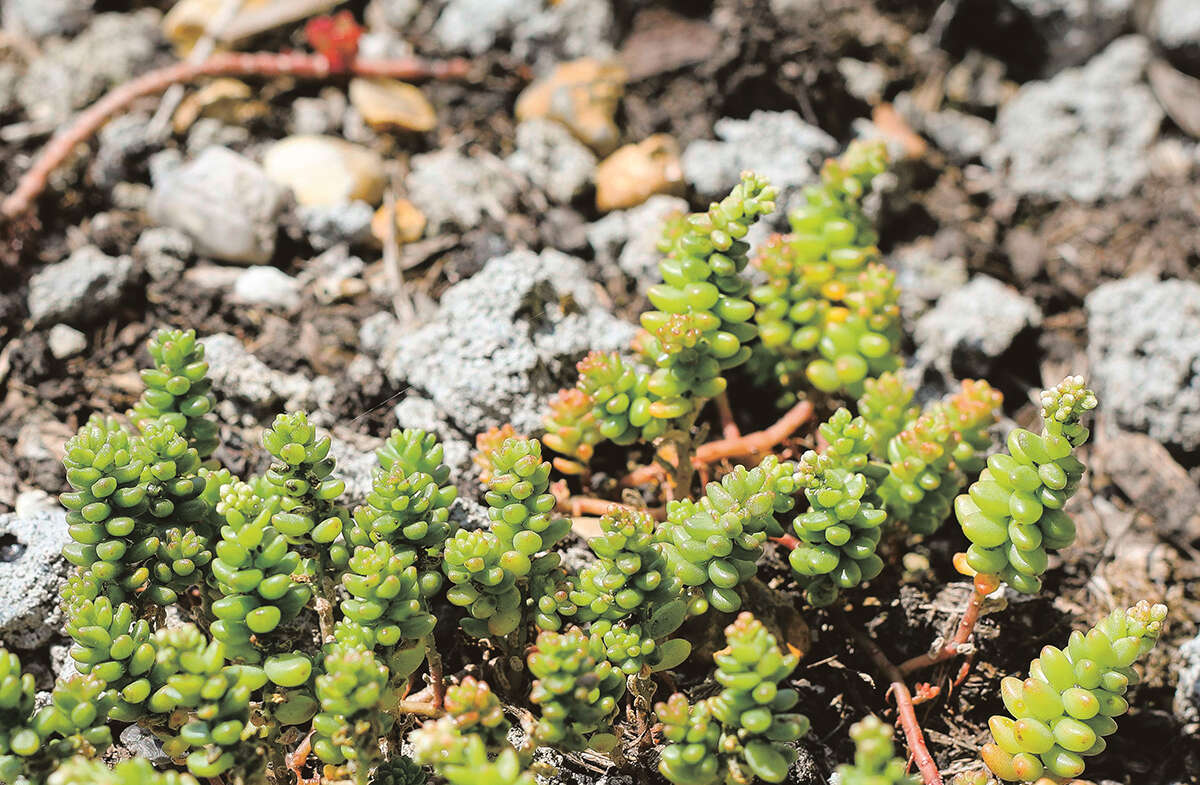
And from something that will make you look down, to something you might have to get on your knees (or maybe a ladder) for. English stonecrop is one of our native succulents, and one reason I like this species is that we often think of succulents as exotic. But they’re not: they’re right here with us and have been for a very long time. The name comes from the observation that it seemed to literally sprout from the stone. Stonecrop grows in mats of clustered, egg-shaped leaves and it loves any corner where water is free to drain away: gutters, dry slopes, and anywhere you can get a sunny, gritty slice of urban life. It has white or pink-white flowers possessing five petals: a star from stone.
Seeds of change
You might wonder why the Nature near you matters, when there is so much Nature elsewhere. You might think that learning to notice a few weeds by the wayside or a bit of plant popping out of the pavement might prove a bit pointless. But coming to know the Nature near you is more than knowing about a few species you didn’t know about before. Sometimes we rhapsodise about Nature without knowing much about it, but in coming to know more, the way we see the entire world can change. What was a flaking brick wall is really a whole habitat, and what were some anonymous ‘weeds’ become ivy-leaved toadflax, jack-by-the-hedge, pellitory-of-the-wall. It’s all about a gradual change of perspective, one where we do not simply dream of ‘getting back’ to a Nature we’ve lost, but notice that Nature is here with us and that, crucially, we are that Nature too.