Donate


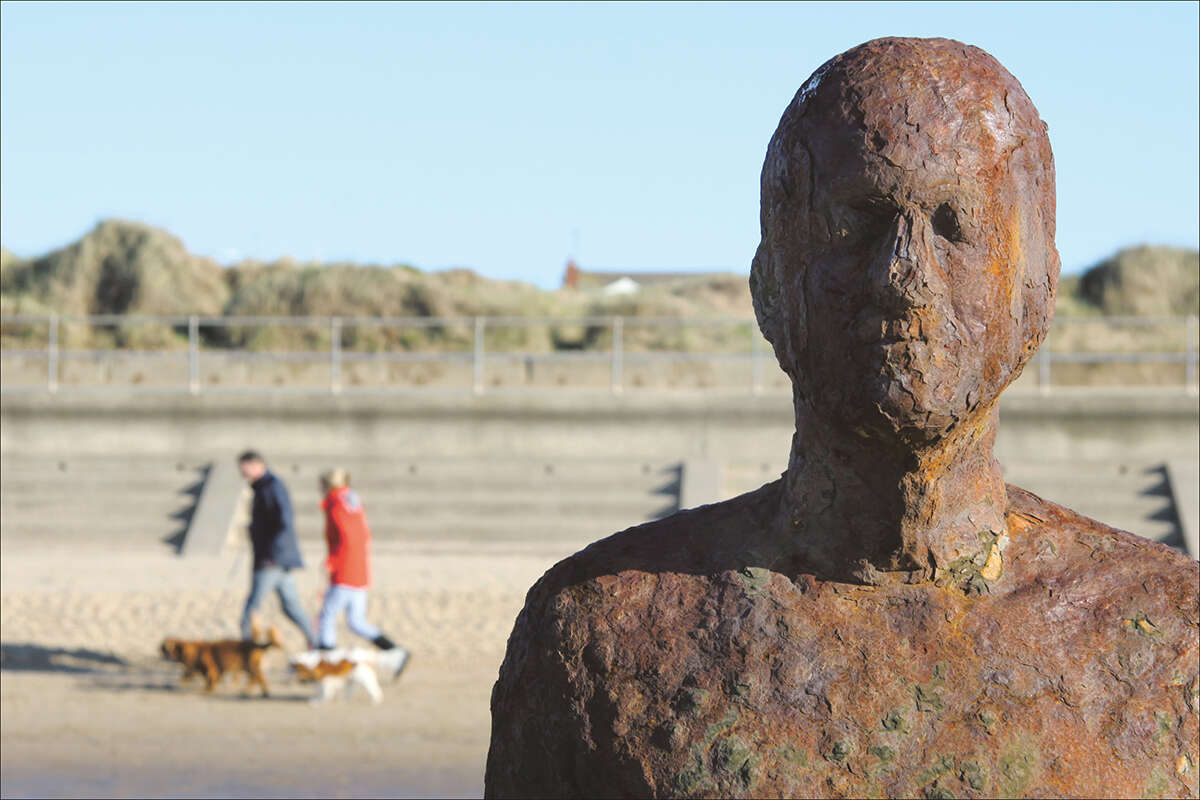
Perhaps the best way to think of the sculptor Antony Gormley’s 100 almost identical figures at the mouth of the River Mersey is as an orchestra: you could think of the statues as the strings, the sands as percussion, and while the tide provides the brass, the horizon the statues’ gaze is fixed upon evokes the woodwind. The strings are stirring in their own right – that’s for sure – but without their interplay with the other instruments they aren’t quite the intended surround-sound.
Yet unlike any other ensemble, with ‘Another Place’ – located in Crosby, seven miles north of Liverpool – you’re never likely to experience the same symphony twice. And that’s because, depending on a statue’s beach location and determined too by the time of day, the scenography is different every single time you look. Just as Tony’s toe might be skimming the water, he might be truncated at the waist, or could be detectable only by the very crown of his head emer-ging like a seal’s.
Earth has now completed 20 revolutions around the sun since the statues were installed in the summer of 2005. That’s twenty years of tide and time ebbing and flowing around them. Twenty years of school trippers sniggering at their nakedness. Twenty years of naysayers tutting at England’s shores interrupted, but equally of approvers profoundly moved by the unique coexistence of art and Nature. Leg-stretching, dog-walking locals have become accustomed to weaving in and out of them. There was even a time when the iron men cut the only human figures they could legally stand within two metres of.
Yet a 20th anniversary was never a milestone Gormley’s artwork was meant to reach. It was conceived to be nomadic, this its fourth beach home after stays in Germany’s Cuxhaven, Norway’s Stavanger and Belgium’s De Panne. As we’re reminded by the very name of the artwork, ‘Another Place’ was designed for displacement, to be loaned and reloaned in the same way as a prestigious painting might migrate gallery to gallery.
As a serial creative director of public artwork installations, including ‘Another Place’, Laurie Peake (currently working on the British Textile Biennial) is best placed to recall its timeline, looking back to when Liverpool, Capital of Culture was on the horizon (2008) and Antony Gormley, then best known for ‘Angel of the North’, was first shown the site.
“Antony was thrilled,” Peake says, recalling the artist’s perception that Crosby was completely different from the other beaches where ‘Another Place’ had been installed. Here there were “containers from all over the world queueing on the horizon, wind turbines in action, the Wirral opposite. It was all going on.
“Plus it’s one of the highest tides in Europe, so there’s drama … a sort of choreography. It’s called the morphology of the beach, the way everything’s continually shifting. He was very excited by it.” Only the price to pay for this alluring drama, Peake also recalls, was the complex ecological and engineering challenge it posed.
“I remember looking at the beach and thinking, ‘easy peasy’,” she laughs. “How wrong could I be?” – referring to unending administrative preparations. First off, a case had to be made that the artwork would bring more than visual impact to the area. “The most important thing for me when you’re putting art in a place is that it has to have multiple impacts. So the projected socio-economic benefits for the area were vital. Then there was the infrastructure to consider – a car park and toilets, etc. – so that even if the iron men were only in Crosby for 18 months, it would at least be leaving a legacy. That really reassured the local authority.”
Most challenging of all were all the consents, Peake remembers, almost wincing at the memory of bulging files. “The whole thing was incredibly convoluted because a beach is effectively in multiple ownership. Sort of like a Neapolitan ice cream … every slice owned by a different authority.” Elaborating, she explains how a delicate balance had to be struck between those championing public art as a means to bring footfall, and those naturally anxious about issues such as health and safety, and potential destruction of natural habitats.
“We had to be patient. And even when all that was in place, there was a long way to go,” Peake remembers of the race to get all 100 figures vertical on metre-high foundation piles within a time-critical three-week window. “The tide had to be low enough and the days had to be long enough. That was never touched on in the media.”
After such an extraordinary feat of engineering and an instant response – “the burger van sold more burgers in the opening weekend than in the whole season previous” – it seemed sensible to consider a longer residency. As a result, a stay of execution was granted to allow time to gather evidence and conduct longitudinal studies to gauge any negative impacts. Eventually – and after twists, turns, U-turns, red tape and red faces – the green light for the sculpture to remain in Crosby was given. Both ownership and management of ‘Another Place’ are now in the hands of Sefton Council.
On the timeline too are the many positive substories the project unwittingly generated: an elusive breed of barnacle – Elminius modestus – thrived in its attachment to the figures, thus providing the perfect research facility for biological scientists; a local Christian theatre group spotted the statues’ potential for spiritual reach and performed plays around them; the statues also remain a permanent fixture on Liverpool Biennial’s festival programme – poster boys for local culture every inch as scouse as the John, Paul, George and Ringo outside the city’s Liver Building.
Though the Tonys were made from casts of the artist’s own body, there’s an unspoken sense that they are Every Man – together yet alone, robust yet fragile, still yet moving, and in the words of the artist himself “just the industrially reproduced body of a middle-aged man trying to remain standing and trying to breathe”. With each touch of the tide, ‘Another Place’ evolves in the same way as any human standing inside a natural landscape. In harmony, you could say.
Vital statistics
Weight (each statue): 650kg
Height: 189cm
Material: Cast iron
Scale: ‘Another Place’ extends over 3km of the foreshore and up to 1km out towards the horizon. Statues stand 250m apart.
Location: what3words: ///large.famed.vote
Visitors to ‘Another Place’ are advised to consult tide times beforehand and not to walk out onto the sand further than 50m from the promenade.