Donate


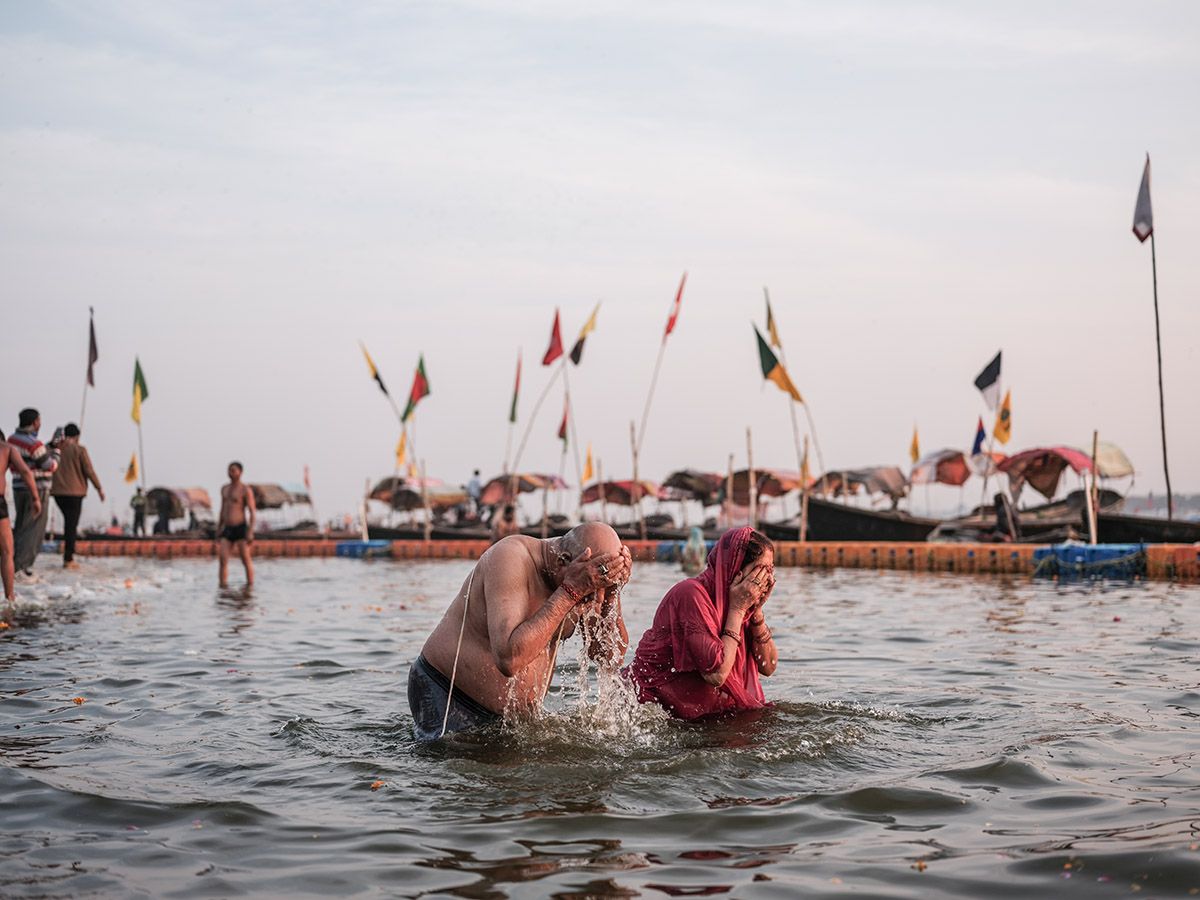
Last winter I visited the Prayag Maha Kumbh Mela pilgrimage festival in North India, which takes place at the confluence of three rivers – Ganges, Yamuna and Saraswati. The climax of the pilgrimage is Nature: a riverbank, not a temple. This year’s was the largest-ever coming together of humans on Earth – more than 660 million people over the 45 days of the festival.
Mela means ‘gathering’ in Hindi. I stayed in a pop-up city that sprawled over 4,000ha. By comparison, the Glastonbury festival site, with 200,000 people, covers just over 300ha and lasts four days. The Kumbh Mela occurs every three years, rotating between four locations, so it comes to Prayagraj every twelve years, when Jupiter enters Aquarius (Kumbh) and the sun and moon move into Capricorn.
This year, Jupiter, Saturn, the sun, the moon and the Pushya Nakshatra constellation were seen in a single line on 29 January – an event that occurs only every 144 years – making this a once-in-a-lifetime opportunity. The ‘when’ of the pilgrimage is of critical importance.
The 660 million pilgrims have a shared objective: to bathe in the waters of the River Ganges at Prayagraj, which means ‘king of the confluences’. The confluence is a symbol for unity through the merging of separate entities – a potent metaphor for pilgrimage itself.
Mother Ganga (Ganges) is considered the holiest river by Hindus, who revere her as a goddess who nurtures, purifies sins and grants moksha (liberation).
The celebratory atmosphere at the Triveni Sangam (Three Rivers Confluence) was palpable throughout 3 February, when the third and final Shahi Snan (Royal Bath) took place. The belief is that bathing at this time will cleanse sins, and on royal bath days the water is thought to turn into amrit (nectar). Bathing at the precise moment of highest astrological potency is the ultimate prize.
I went in the morning and the evening. The atmosphere was joyful, not solemn, with people splashing each other, despite the tragic stampede of the second royal bath a week before – which, intriguingly, no one I met mentioned.
Before I went to India, I was asked: “How do you get there? Where will you stay? And why do you want to go anyway?” I got to the Kumbh Mela and back from Prayagraj airport on the back of a motorbike without a helmet through chaotic traffic and up the wrong side of the road. I slept on the ground in the simple tent of a group of sadhus (holy men) whose hacking coughs ensured I got very little sleep.
Why I went was more interesting.
My decision came from a strong feeling that I simply had to go, after my friend Kamya Buch told me this was “the big one”. I had recently been to the guru Amma’s ashram in Tamil Nadu, and the Hindu spirituality there increased the love I felt in my life. Naturally, I wanted to see the most concentrated expression of mass Hindu and Indian culture in the world. I was also fortunate to have as a guide Jim Mallinson – an honorary mahant (high-ranking sadhu) in his community, fluent in Hindi, and a veteran of many Kumbhs.
Ten years ago I co-founded the British Pilgrimage Trust to revive pilgrimage in modern Britain for people of all faiths and none. I’ve walked river pilgrimages in Wales, and one to a confluence of three rivers in Hertfordshire. But here was the largest pilgrimage in the world, and I wanted to learn from it.
The Kumbh changed me in ways I couldn’t predict – an inarticulable appreciation that a culture can operate in radically different ways. Everyone I met was happier, smilier, carefree, vital and with a light in their eyes rarely, if ever, seen in the average westerner. They were kind – not just to me as an exotic visitor, but to each other. They lived in community easily, even with animals – dogs, cows, camels, elephants. The sheer scale and peace of this mass gathering is unimaginable in Britain.
The sadhus and babas (revered and respected men) initially triggered a conditioned reflex in me to distrust the hyper-masculinity and strict hierarchies. But the longer I spent with them, the more I ‘got’ it. Their life force was immense. One night, I stumbled into a feast for a hundred sadhus and was overwhelmed by their presence. These were the most present people I’ve ever met.
I think of myself as having above-average spiritual development for a Brit, but next to these men I realised I’m still in the foothills. Their spirituality is embodied. It’s not about belief. It’s about action.
Next to my tent was the jamat (travelling monastery) of 50 men known for their perpetual pilgrimage around India. After the royal bath, they would sit cross-legged in circles of burning manure under the sun for four months. Their leader, Jagannath Das, a 30-year-old yogi, had just completed their 18-year initiation. His guru, Prem Das Moni, has been silent for 38 years. In our culture, Jagannath would be a celebrity. In theirs, he just sat quietly on a cushion.
I spent hours with them, wordlessly, and they welcomed this. Connection didn’t require words. They barely spoke, even on feast night. The average westerner would feel awkward – but here it felt completely natural to feel my way through the day, not talk it.
Visiting the transgender Kinnar Akhara camp was similarly intense – dignity and courage powerfully expressed through physical ordeal and self-realisation. Its members had curated a modest gallery of their art, expressing images of love.
As someone who is trying to revitalise pilgrimage in Britain, I wanted to understand how I could bring something of this home.
The day I bathed in the Ganges was also close to Imbolc and Candlemas – festivals marking the midpoint between winter and spring. They honour another goddess and saint: Brigid, also linked with sacred water.
Few realise that the Glastonbury festival coincides closely with Pilton parish’s patronal feast day – St John the Baptist, on 24 June. Could we reimagine Glastonbury festival as a modern pilgrimage, arriving on foot from Wells or Glastonbury town, celebrating joy and music? Music is, after all, a river of sound, drawing together opposites and creating unity. It is the west’s favourite form of shared presence.
The Indians at the Maha Kumbh Mela know something about the body, soul, Earth and cosmos that we in the west do not. Our educational systems aren’t yet prepared to believe what theirs reveal to be possible.
But one thing is sure: whatever they were doing at the Kumbh, I didn’t see a single sun salutation or downward dog. Perhaps a good first step for us is to walk the rivers near where we live – from source to sea – stopping at confluences, setting an intention at the source for what we want from life’s flow.
This is an edited version of an article first published on the British Pilgrimage Trust website.