Donate


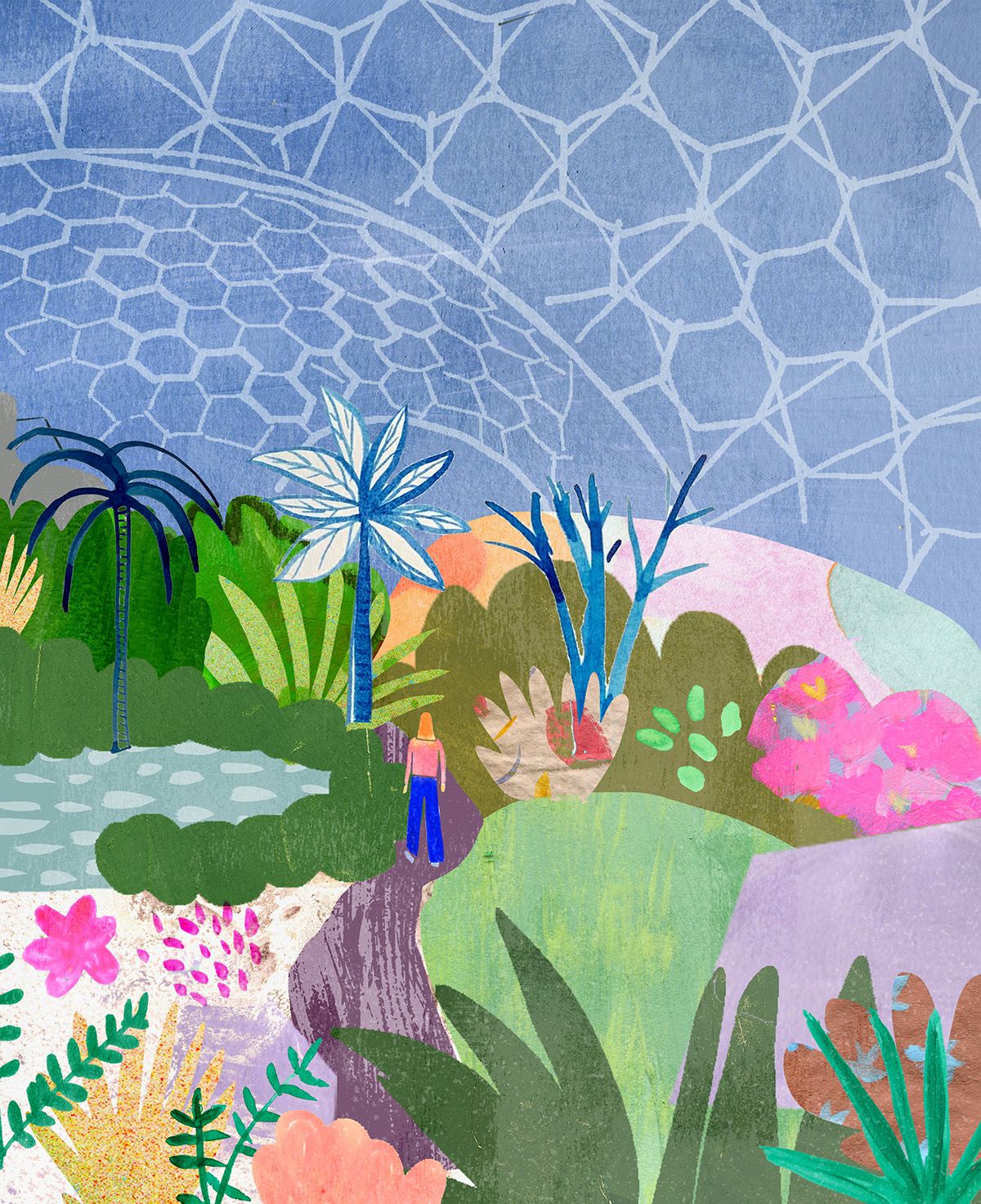
The Eden Project will be 25 years old in March 2026. It seems like a good moment to reflect on its genesis, its present condition, and the direction in which its future may lie.
All things have their moment, and many things continue well beyond the time when that moment burned brightly. It is the thankless task of leaders of organisations the world over to protect the entities they love from becoming irrelevant, preserved only in the strange aspic of nostalgia, existing merely to defend the vanities of their founders, who have ceased to be awake at the wheel. It has been said that people first form institutions and then the institutions form them. All who read these words will recognise the symptoms.
What began as a fantasy among a group of horticulturists and would subsequently inspire the creation of a project that changed so much, including how we perceive horticulture and how we interpret science, was light-hearted. It was not weighed down with heavy idealism. Instead, it drew people from across the country to dream of a Great Exhibition contained within marvellous structures, capturing something of the spirit of Arthur Conan Doyle’s lost world. A crater of a volcano, home to a secret kingdom of life, hidden from all prying eyes.
People say that we were visionary. The truth is that every 10-year-old in the country imagines such things, whether it’s building huge dams, mad Ludwig castles on improbable mountain peaks, or hidden kingdoms beneath the earth. To dream, to imagine, to stretch and aspire – this is what it is to be human.
Jonathan Ball and I went to see the architect Nick Grimshaw (who died September 2025) and his team. We told them plainly: we could not pay them, for we had no money. Yet we had a dream – one that might, one day, become the eighth wonder of the world. If they dared to risk working for nothing, then that prize could be theirs. And so it came to pass.
Since it opened on St Patrick’s Day, 17 March 2001, around 25 million people have visited Eden. The spirit of its construction was enshrined in a handwritten letter signed by me and Cullum McAlpine. We agreed there would never be litigation between us. There never was and the project was built on time and on budget.
The details of how we built it and the human story behind it are well documented elsewhere. But one of our driving forces was to demonstrate that being an environmentalist did not mean presenting as either bohemian or ‘alternative’. Idealists should be able to read a balance sheet and project-manage at scale. Our MD, Gay Coley, coined the brilliant phrase, ‘Dare to dream, organise to deliver’. That became our motto.
We wanted to put local sourcing into genuine practice, not play at it. It was hard work – many uphill battles – to transform how businesses and funding agencies might collaborate in wealth creation. Eden has since been independently assessed as having created approximately £2.2 billion for the local economy. This, in turn, has led us on a journey we call ‘muscular localism’, where we explore how to build genuinely resilient economies. Inspired by the Atelier LUMA in Arles, in the south of France, we have begun a deep audit of local resources, both human and natural, while working with others to see where modern technology can revitalise traditional practices.
Alongside this, like so many others, we became obsessed with the madness of our dependency on fossil fuels. Five years ago, we began excavating a deep geothermal facility – a pipe 5.2km into the Earth. Abundant, cheap renewables will transform our world, enabling us to grow what we need where we need it. We stand today on the cusp of the greatest revolution since humankind first set out on its journey. Yet we live also in a time of widespread unease. I need not rehearse the litany of doom. I will simply say that I believe that within 30 years our world will be transformed for the better.
Last year we opened a vast Oriental Eden in Qingdao, China. We are building new projects in Morecambe, Lancashire, and in Dundee, Scotland, with several more in the pipeline overseas.
Eden has a strange effect. When it is announced that we are coming to a place, the local community seems to feel a weight lift, like a strange exorcism that banishes despair or hopelessness and replaces it with hope and aspiration. The truth is that we act as a lightning rod for the talented people already living there, giving them the confidence to express themselves. It is never our Eden. It is theirs.
The main point I wish to make is that experience has shown me that humans like doing good things at scale. And it is not about plants or education, but about lifting our collective eyes to a horizon rich with promise. In a world that has developed the economist’s limp and the accountant’s whine, let us remember that almost everything we admire comes from the desire to stretch ourselves.
So, I ask a simple question: have you faith that any of our current leaders can dream great things into being?
Eden’s ultimate contribution to our cultural life is the gift of permission – to dream.
Lock up the dream-squashers and perhaps have a soft tattoo put on your bum that reads: ‘Dare to dream, organise to deliver’. Then watch what we clever little humans can do, if only we are let off the leash.