Donate


The first issue of Resurgence magazine in 1966 marked a mid-point between two of the most important catalysts for the modern environment movement: the launch of Rachel Carson’s book Silent Spring in 1962, detailing the devastating impact of pesticides, and the publication of ‘Earthrise’, the iconic blue-green photograph taken of the planet during the Apollo 8 space mission in 1968. By 1970, millions of people globally were taking to the streets to protest against environmental destruction, and a new global green movement was born.
Alongside oil spills and species extinction, this era also shone a spotlight on our food and farming system, which, driven by a desire for greater yields, was changing at a rapid pace and being taken over by intensive farming practices and inputs such as pesticides and fertilisers. Here in the UK, this alarming trend was already being highlighted by the Soil Association, which had championed the benefits of organic food for over 20 years, thanks to its formidable founder, Eve Balfour, one of the first women to study agriculture at a British university.
Over the next 20 years, other lighthouses appeared. Friends of the Earth, Schumacher College, the Organic Research Centre and the beginnings of what was to become the UK’s food and farming movement were under way. These organisations were supported by a counterculture of wholefood shops and bakeries that were also starting to emerge. Ceres Bakery in London, set up by Craig and Gregory Sams in 1972, was the first bakery in the UK to use sourdough and produce naturally leavened breads.
But while efforts were now being made to lobby government and make the public aware of the dangers of the industrial food system, farming in the UK was being overtaken by corporate interests. The sad demise of the small family farm in the UK can be directly traced back to prime minister Margaret Thatcher’s policies of neo-liberalism, which did away with the research councils that provided the free information farmers needed to grow food. Such policies encouraged those with a commercial interest to fill that space. Over the next few decades, farming turned away from centuries of knowledge and community traditions towards industrial agriculture, with its emphasis on high productivity demanding large-scale mechanisation, monoculture and chemical inputs, as well as intensive livestock production.
By the early 2000s, when Colin Tudge wrote So Shall We Reap, farmers were in the stranglehold of the ever-powerful supermarkets, who demanded cheap food at any cost. The ensuing loss of biodiversity, damage to rural communities, and rising environmental and health impacts were not part of the conversations taking place in the boardrooms or corridors of power across the UK. And so, in 2009, a new conference was proposed: one that would take place at the same time as the long-running, corporate-sponsored Oxford Farming Conference (OFC) but would address how we could work with Nature rather than against her.
The co-founders, Graham Harvey, Colin Tudge and Ruth West, intended it as a fringe event to the OFC, so it was held almost directly opposite in the Old Library of the University Church. (Oxfam had met there for the first time in 1942.) It was to be a conversation about how farming could be if, as Colin put it, it were “designed expressly to provide everyone, everywhere, with food of the highest quality, nutritionally and gastronomically, without wrecking the rest of the biosphere”. Graham and Colin had worked together at Farmers Weekly and seen what was happening to farming, which was now “deemed to be a business like any other”. The three took out their address books and invited everyone they thought would be interested to join them. The result was a packed library and a determination among those who attended that this was not to be a one-off.
In the years that followed, the Oxford Real Farming Conference (ORFC) began partnering with both established and emerging organisations, and a growing community, to programme a conference that would, in part, restore hope to many who believed that food and farming should be at the centre of society. Satish Kumar, the founder of the Resurgence Trust, says: “The Oxford Real Farming Conference is where people can come together and say, ‘We are not going to accept this monopolistic and very centralised and very controlled food market where food has become a commodity. We want to see food as sacred. Food is for health. Food is for people.’”
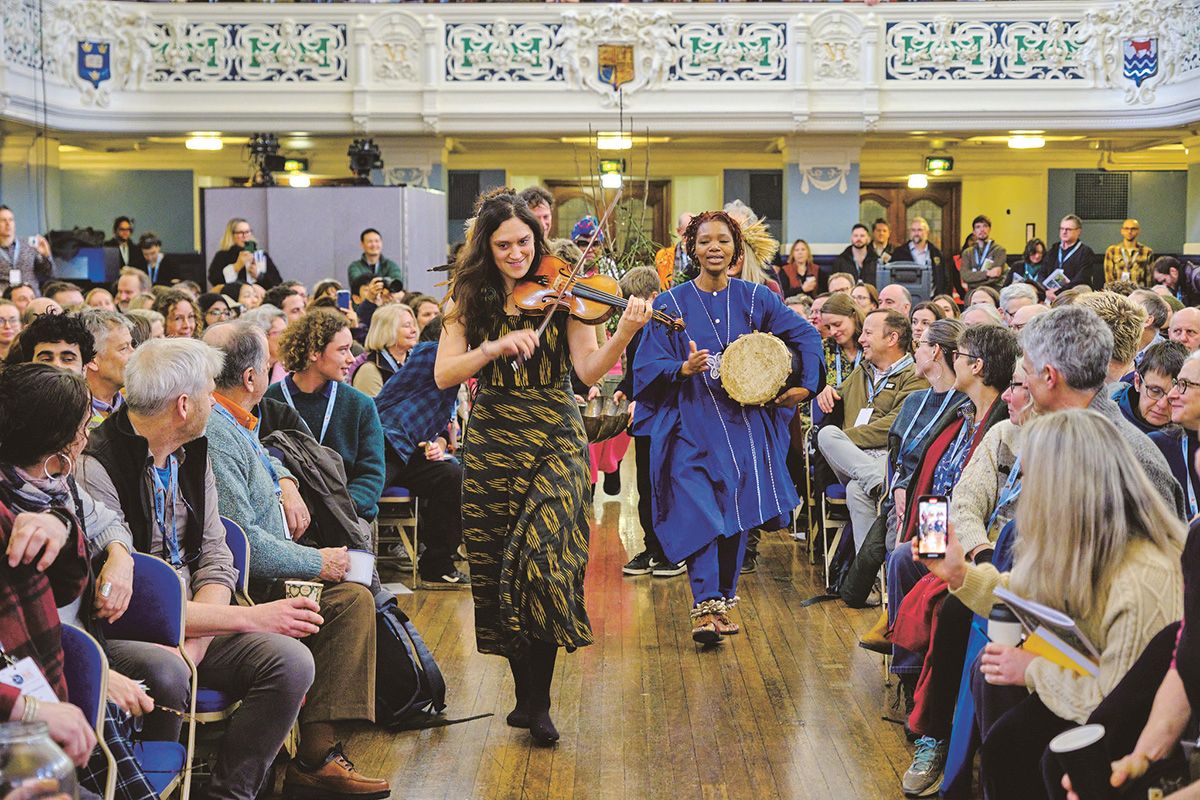
From these humble beginnings, the ORFC has become the largest agroecological gathering in the world, attracting nearly 2,000 attendees to Oxford every January and up to 3,000 online. Never was this message of hope more evident than during the pandemic, when it transformed from an in-person event into a global online festival that brought together speakers and delegates of farming communities from 125 countries. Working across 19 time zones and using 10 languages (with a team of 38 interpreters and translators), the conference forged global friends and allies who continue to feed into the programme and share their knowledge today. In January 2026 the ORFC will welcome speakers and delegates from La Via Campesina (the largest social movement in the world, with approximately 200 million members), the Alliance for Food Sovereignty in Africa, and the International Panel of Experts on Sustainable Food Systems (iPES-Food).
The conference is programmed by a call for submissions, which asks the wider community to put forward ideas for around 150 sessions. In this way, the team can see what’s alive for the movement in terms of practical knowledge, pressing issues or just topics they wish to explore. This process led to the establishment of a Justice Hub in 2022, which allowed space to enquire into race and inequity within the food and farming movement. Also in recent years, the conference saw a keen interest from delegates to talk about a more heartfelt or sacred connection to land. These ideas turned up in many guises, from intuitive farming workshops to an interest in Indigenous knowledge and traditions to robust discussions around the rights of Nature, and what was clear was a rising interest in exploring a more reciprocal relationship with the natural world.
This has now become a programme of work called Listening to the Land, which is seeded through the conference. It also creates gatherings throughout the year and has a stand-alone day in January (the day before the ORFC) that attracts an ever-widening circle of people who feel the call to connect more deeply with the land. They are a diverse mix of farmers, food producers, land workers, activists, walkers, animists, policymakers, academics, alchemists, healers and people from many other disciplines, but all share a belief that we must be open to another – more intuitive – way of knowing and listening to Nature at this time of crisis.
One of the greatest advocates of this way of being has always been Satish, who in his 90th year will make the journey to Oxford again this January to support the food and farming movement and the inherent principle that we are Nature, not separate from her. Like his fellow activist Mariame Kaba, Satish teaches us all that despair is a luxury and hope is a discipline. And this is never more evident than in the three days when these events take over central Oxford and people rush between sessions animated and alive with ideas of a different way of doing things.
The main venue of the conference is Oxford Town Hall. If you turn left out of the front door and take ten steps, you will see an old Victorian-style lamp post. This is the lamp post that features in C.S. Lewis’s book The Lion, the Witch and the Wardrobe, with its promise that another world is possible. There are many reasons people come to Oxford in the first week of January, but most are motivated by hope and would agree with Lewis’s words: “You can’t go back and change the beginning, but you can start where you are and change the ending.”
For more of Satish’s thoughts on food and farming, listen to this interview with him at the time of the 2023 conference.
You can obtain tickets to the Oxford Real Farming Conference and the Listening to the Land event by visiting www.orfc.org.uk