Donate


Walking into Tout Quarry on the Isle of Portland, one can see layers of deep time revealed before one’s eyes. It is said that in this deeply excavated, now silent landscape every foot of rock face represents a million years. But the quarry reveals layers beyond deep geological time: the excavations were made by stonemasons over hundreds of years, and their legacy has been preserved here by the Portland Sculpture & Quarry Trust (PSQT), who have also made space for contemporary artists to exhibit works that respond to their environment amongst the flourishing flora and fauna also protected by the Trust.
The sculpture exhibition One Island – Many Visions is the result of a collaboration between PSQT and 27 members of the Royal Society of Sculptors who have visited over the past 18 months to create work that responds to the quarry – its geology, social and industrial history, current community and burgeoning plants and wildlife – as well as wider issues such as changing climate and human extractive habits. The exhibition takes place in the quarry, where members of the public come across artworks as they walk, as well as in the large Drill Hall Gallery.
Some of the artists have chosen to focus on time itself as their central theme, struck by the living rock, by piles of stone the masons have discarded, and by the huge number of fossils that have been lovingly collected and stored in the Drill Hall over a 40-year period by Hannah Sofaer, creative director of the Trust. For me, being allowed to touch these ancient fossil stones as we cleared the Drill Hall to prepare for the exhibition was a deeply moving experience.
Cornish sculptor Seamus Moran’s work questions accepted norms and re-interprets familiar objects to give them new meaning. Dorset is famous for its Jurassic fossils, and Seamus’s response to the quarry was to create a series of Anthropocene fossils, which reflect the impact of humans on the fauna of the planet, projecting a dark and sobering vision of what the fossil record may say about the legacy of the human race in the distant future. In ‘Tales from the Anthropocene’ he has taken casts from the rocks at Tout Quarry and created a new ‘fossil’ set into this rock from the cast of a gannet he found on a beach, the blue nylon rope on which it had choked still sticking out of its beak.
Ros Burgin, another exhibitor dealing with time, often uses globally traded materials to consider the meaning of ‘value’ and to highlight sustainability issues. Her delicate installation in the quarry involves simply gold leafing a triangular point of stone where one rock rests upon another. “Gold was created in outer space,” she explains, “when two neutron stars collided in a rare cosmic event. Portland stone was formed in the southern hemisphere 150 million years ago. My sculpture is a point of contact that draws attention to the physics and time at play in this deeply excavated site.”
Stonemasons have battled for years with the presence of chert nodules, single-cell marine organisms that have precipitated into rock-hard clumps. Himself a stonemason, sculptor Roger Stephens has created an exquisite depiction of these organisms, with their intricate silica skeletal structures, in his work ‘Lamprocyclas Maritalis’. Another of his pieces, ‘Campylodiscus Hibernicus’, depicts a diatom, a single-cell form of algae with a silica casing, which occurs worldwide in salt water and fresh water. These organisms capture carbon dioxide as part of their photosynthesis process, and are so numerous that they produce 20–50% of the world’s oxygen.
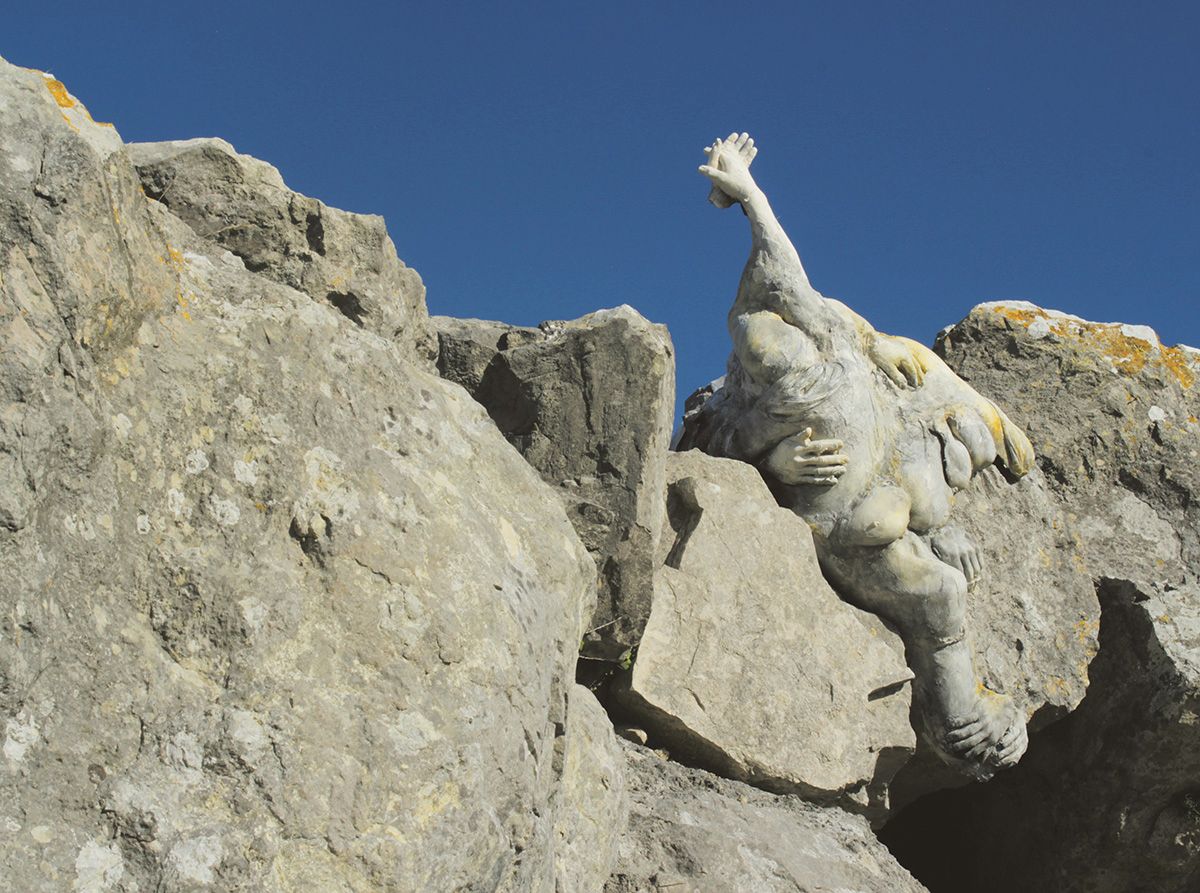
For me, the quarry inspired a fascination with the contrast between human time and deep geological time, as between the fragility of weathered plaster and the permanence of stone. My wall-based work ‘Time Worn’ also plays with and undermines traditional parallels made between landscape and the female form, representing the ageing body as beautiful and sacred. Out in the quarry, my site-specific sculpture ‘Passing Through’ ‘embraces’ a skyline rock. It, too, plays with contrasts but also seeks an equivalence between rock and plaster, the human and the more than human. The work is ‘other’: a mix of human, rock, animal and plant – all existing on this planet through time. Neither specifically male nor female, but rather simply human, the hands call out, from the skyline in particular, as a reminder of the human hands that worked the quarry and shaped the landscape.
Both pieces, and the smaller ‘Strange Finds’ fossil-like objects, are constructed from sections of life casts that were used in previous sculptures and then left to weather under trees over winter, the white plaster slowly softening into more natural hues as spiders and leaves began to inhabit its nooks and crannies. Siting the plaster work outside continues this eroding process, which is deliberately out of my aesthetic control. This effective ‘recycling’ of works adds another element of time-based meaning to the depiction of ageing bodies.
In my work, the emphasis on hands celebrates the work of quarry people from the past and of people still working with their hands today. And for me the hand is also integral to an appreciation of the way in which there are different manifestations of human intelligence, and that some of these intelligences – the touch and feeling that sculptors are deeply involved in – are likely to be crucial as we struggle to reconnect with our embattled planet. The quarry sculpture ‘Passing Through’ appears to embrace the rock, just as we need to learn to embrace our planet – understanding our equivalence with fellow beings rather than insisting on our superiority.
One Island - Many Visions ran from 6 September to 31 October 2025.