Donate


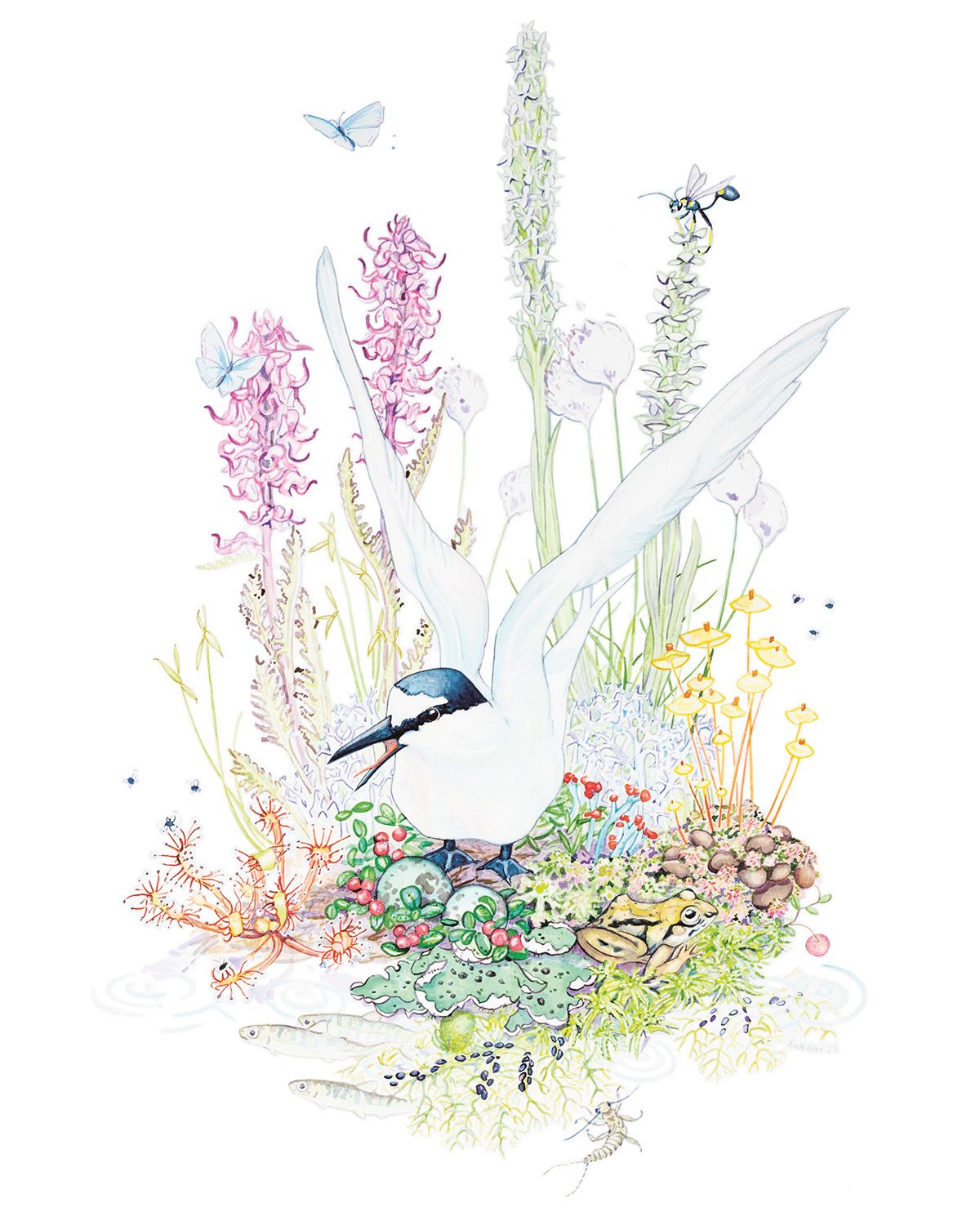
Traditionally, bogs have had a bad press, particularly in literature. Take Beowulf, for example, the Old English poem in which the antagonist Grendel is believed to have lived in a swamp. Or The Hound of the Baskervilles, in which the eponymous hound is said to lurk on the fictional Grimpen Mire in the middle of Dartmoor.
In her new book on peatlands, Alys Fowler takes this idea of bogs and dark, wet places being the homes of beasts and monsters and turns it on its head. In fact, she takes it further and characterises the bog itself as a beast: “I have such a strong sense of each peatland as an individual that I can almost smell their breath, hear their winds moan, feel their spirit,” she writes. “When their lands are ravaged … you learn to read how they once were. How they once rose over the landscape, these ancient slumbering beasts. And how they might again.”
Peatlands, she tells us, make up around 13% of the UK’s land-mass, and peat can be found in at least 180 countries across the world. Half land and half water, peatlands wouldn’t have been possible before the spread of plants. They began to form around 370 million years ago and have been storing carbon ever since. One of the most striking statistics in the book was the revelation that peat stores around 600 gigatonnes of carbon dioxide world-wide. But peat only stores carbon if it’s wet, and then “it holds the balance of life in its body because the peatlands are one of the ways in which this Earth stays cool enough to be inhabited.”
This is a beautifully written, forensically researched book, covering every aspect of Fowler’s subject: the different types of peatland; the structure of a bog; why bogs are so important to clean drinking water; the complicated relationship of bogs to trees and to fire; the idea of the bog-as-a-being; the concept of it as a library or archive; the devastating effects of burning, cutting and pollution; and finally the difficulties and contradictions inherent in our attempts to restore degraded peatland.
Fowler is perhaps best known as a horticulturist and journalist. As you might expect, when it comes to peat her own profession doesn’t come off lightly: “I’ve been involved in campaigns for banning peat-based composts for the entirety of my horticultural career,” she says, revealing the sobering fact that we use around 1.7 million cubic tonnes of peat every year just to grow plants.
But horticulture isn’t the only culprit. For centuries peat has been cut for fuel, burned as part of land management for grazing or grouse shooting, exposed to industrial pollution, and drained for afforestation. Paradoxically, even attempts at restoring peatlands can undermine the very effects they are trying to achieve. On one level, the solution is simple: “You ‘just add water’.” But restoration costs money, and that brings its own set of problems, not to mention the thorny issue of how much time we have left to reverse the damage we have done to these magical landscapes.
This is not just a book about bogs. It’s a book about love: love for the land, the planet we live on, and the people we share it with. Fowler has a very engaging writing style: “I want – I need – you to love these spaces.” I’m slightly embarrassed to admit that the end of the book brought a lump to my throat, as if I’d just finished an absorbing novel full of characters to whom I’d become attached. Which is a testament to the quality of her writing.
I had never thought of peatlands as places of enchantment. Mysterious and intriguing, yes, even fascinating. But Fowler has shone a light into these “dark places”, which are not really dark at all, but full of life, history and wisdom, and of secrets that could save us all, if only we will listen.
Peatlands: A Journey Between Land and Water by Alys Fowler. Hodder Press, 2025. ISBN: 9781399727563