Donate


One problem with the ordinary is that, in being ordinary, it risks going unnoticed. This can happen even in the most extraordinary places. I first discovered this when, after university, I got a job as a security guard in the Royal Pavilion in Brighton, England. The Pavilion is a vast pleasure palace whose architecture and furnishings are a lavish meld of the ‘Oriental’, Indo-Saracenic and European. While working there, I heard many describe the palace as beautiful, magnificent and opulent, but after a week strolling up and down the same hall, chamber or anteroom, I realised that the beautiful had become banal. Often, the process of getting through the day hides the richness around us.
In 2024, I won an artist’s commission with the New Forest National Park Authority (NFNPA). With this commission, I wanted to explore the ordinary lives lived in this extraordinary place, particularly how language and place connect in this historic landscape straddling the counties of Hampshire and Wiltshire. I was especially interested in a group of New Forest dwellers known as Commoners – people who, through their link to the land, hold the ‘five rights of Common’: pannage, turbary, estovers, pasture and marl. These words conjure a very old way of life, but the rights continue to shape the fabric of the Forest today.
Pannage: Sometimes known as ‘mast’, this is the right to turn out pigs to roam the Forest and eat acorns, among other things. This practice helps to protect ponies, as acorns can poison them.
Turbary: The right to cut turf for fuel. Due to environmental concerns, this right is no longer exercised.
Estovers: The right to gather firewood from the Forest. The amount a Commoner can collect is related to the size of their property.
Pasture: This is the right to turn out animals – such as ponies or cattle – to roam and feed in the Forest.
Marl: The right to dig clay (marl) in order to spread it on fields as fertiliser. This is rarely practised today due to environmental concerns.
These words are part of the everyday language of Commoners, as well as the Agisters, who help organise them, and the Verderers, who oversee the legal protections of the Forest from their Verderers’ court in Lyndhurst. For my commission, I interviewed those whose lives were in and of the New Forest – people who lived in an extraordinary place, every ordinary day. I sought to capture their voices, stories and language in order to create an audio portrait of the Forest.
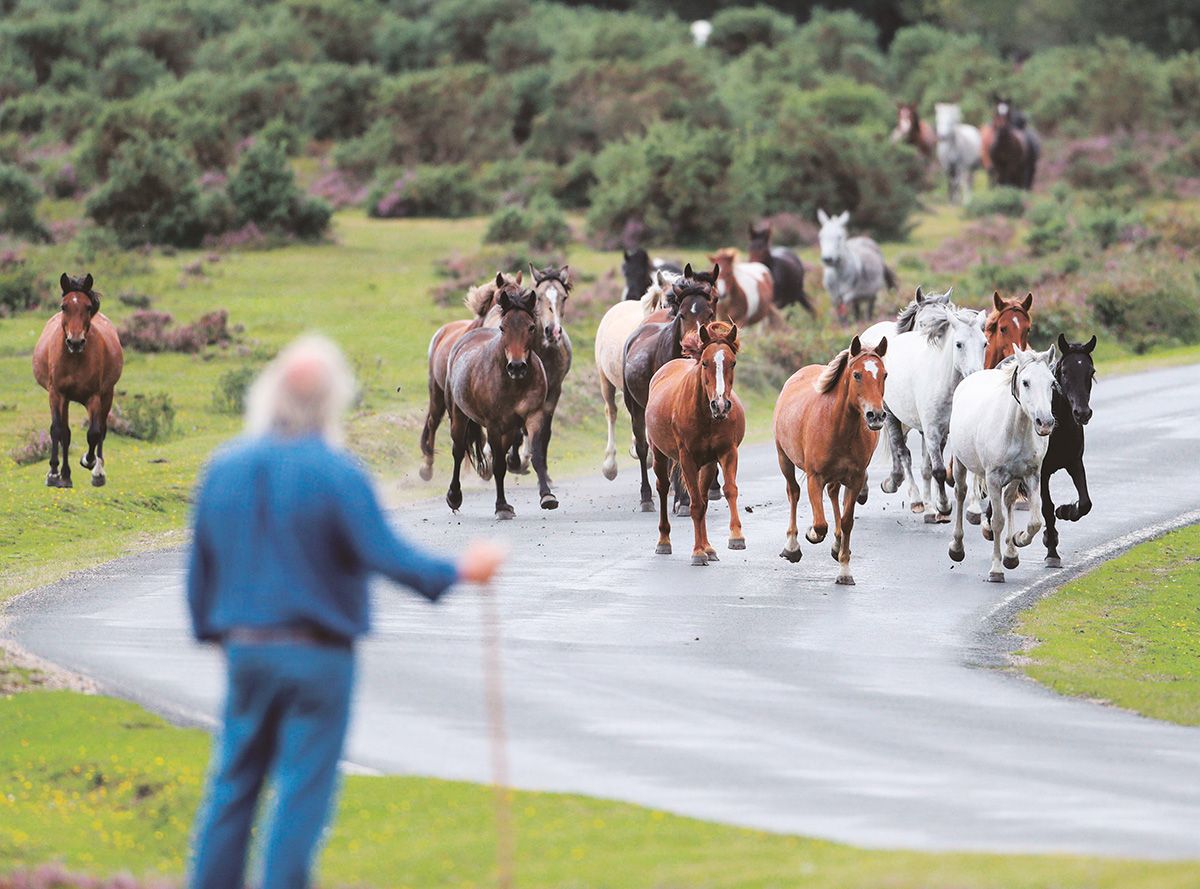
One crucial thing I noticed interviewing people was that their connection to the landscape, and the language they had for it, seemed so unremarkable to them. For me, though, it was a doorway into a richer and more complex place. If you know that cattle out on a sopping wet common ‘poach’ the ground with their hooves, you become attentive to that shape and to the habitats it can bring. Then there are the ‘drifts’, times of year when Forest riders gather ponies into enclosures, known as pounds, for welfare checks. I have heard Commoners describe being out on a drift and noticing in the distance one of their own ponies among others, by the merest outline of its form. What this tells me is that people are not simply doing tasks that need doing. They are living the layers of a very land-intimate life.
In keeping with my subject matter, my interviews did not take place in studios but en plein air, as painters would say: amid strong winds and steady engines, accompanied by the clink of cutlery in busy cafes and the moan of cows with prolapsed wombs, among water and muck and the business and busyness. From the outside, the New Forest can seem like a beauty spot, but is very much a working landscape. The business and busyness of many I met banished any sentimental idea of a simple rural idyll, quiet and contemplative. Instead I found a landscape of vigorous and ceaseless activity – of flora, fauna and funga, of which we humans are part. I heard stories of midnights spent out in freezing rain trying to find an injured pony, of having two, three or four jobs to keep life going, of a constant defence of rights and boundaries, of stubborness and a quiet but searing pride in the Forest as a place, a history and a community.
My work interviewing and making field recordings resulted in Pannage, an audio portrait driven by the sounds of the New Forest, with each interviewee forming a layer discussing their places, their language and their ordinary. I adopted a technique known as ‘contrapuntal radio’, where voices merge, fade and mix, sometimes giving the listener the sense of jumping into a conversation or sitting in a room where different voices compete. We overhear as well as hear. In this way, the audio portrait does not simply document land and language, but attempts to give a layered sense of a community and its speech by using voices alongside the sounds of the everyday. It seeks to capture the Forest’s business and busyness, and you can experience it for yourself by clicking the audio player at the end of this article.
While we might not notice it, we ask so much of the landscape. It nourishes our bellies and literally grows our bones. It is home. It is the ordinary and, at moments, the extraordinary. It is the place of our families, but also of our ancestors, of people who follow a similar way of life, of those who are ‘our’ people and of some who will remain unfamiliar. When in the Forest we might pause and look out from the damp crossroads at a landscape that can seem so flat: half-broken views sculpted by browse line and pony path through gorse, poached earth, car-crunched acorns that will soon provide pannage for pigs. At times like these we might think little of such sights because we are busy – always busy – or because we are heartsore, double-booked, or simply tired.
But this is perhaps why we ask for artists, and why organisations like NFNPA commission the work of creatives. Artistic expression and the necessary abstraction of art calls attention to its subject and reframes the ordinary so it can be seen and heard again. Art is an opportunity to take flatness and to open it out, performing its many layers. It reminds us that any landscape that seems simple is nothing of the sort, and that the land and the language that daily go unnoticed can, with a little effort, be seen and heard more clearly.
This article was possible due to work commissioned by ArtfulScribe and supported through NFNPA’s Sustainable Communities Fund as part of NEWRITE, a two-year literature development project based in the New Forest and supported through public funding by Arts Council England. You can listen to Pannage by clicking the Play button below.