Donate


We are crossed
by the River of Dreams
the River that names us
the River that remembers its own name
Upon it, Vessels sail
Vessels carrying Forests
Forests of organs and master cells
Forests of mountain heads
Vulva-flowers open,
skins of memory unfold
Mother trees rise
Mountains open themselves
Paths open themselves
Paths opening into paths
opening into Water
until all,
return
to Sea.
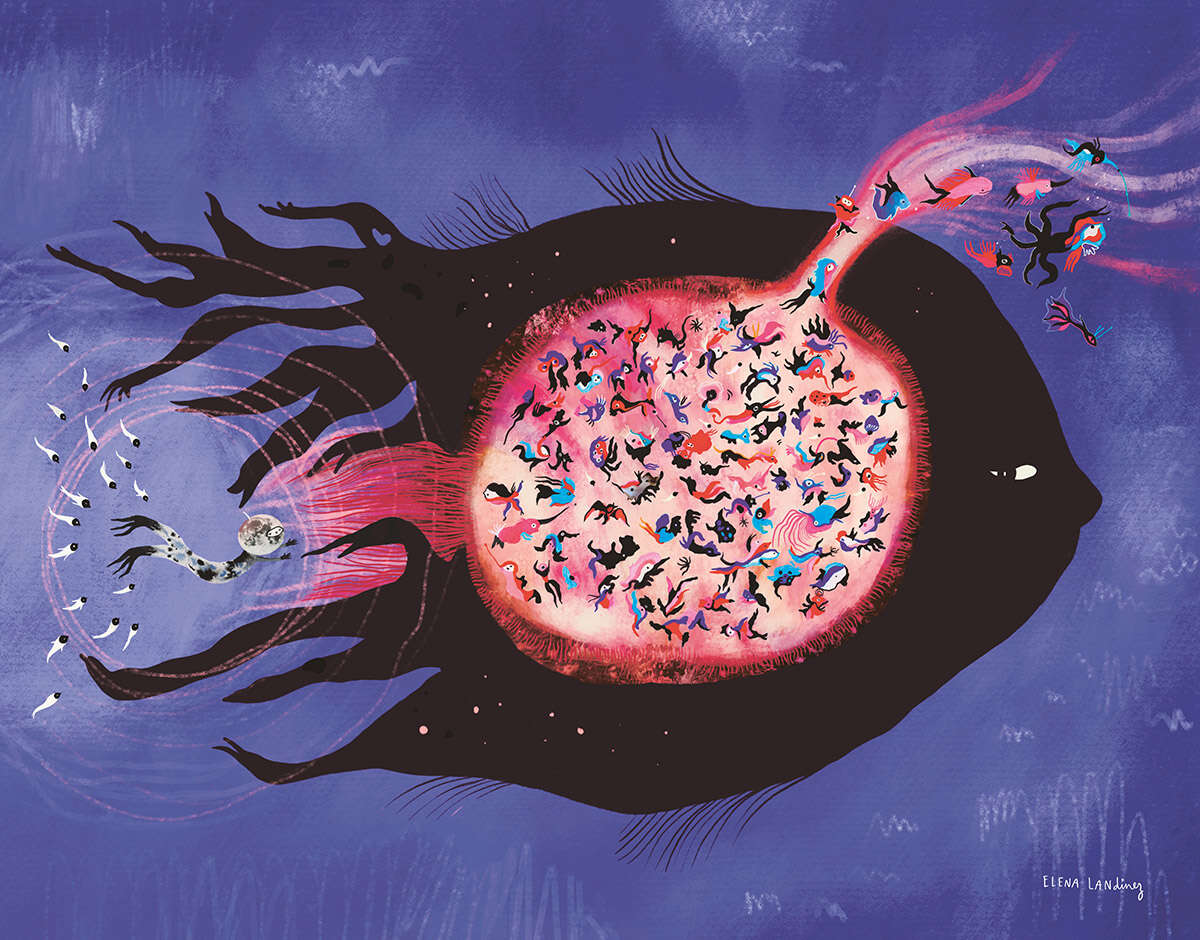
From this continuous movement between bodies and landscapes, interiors and currents, questions begin to emerge. If we could see whales from the inside, what would we find? What if cargo ships were filled with seeds, destined to reforest the world? And inside a river dolphin – what might be there? Are they made only of flesh, of water, of the debris they ingest? Or are they also composed of gardens, flowers, forests, all travelling together? What if horses could ride vessels, their hair flowing in the wind?
I inhabit the space of what if, a territory shaped by imagination, dreams and contemplation, yet never disconnected from everyday life or the urgencies of the present. The things I encounter in the world feed my imagination. Dreams are a vast sea of the unknown, of mystery, of the unconscious. I search for their traces in waking life. While inside them, I move freely, meeting others, flying, passing through things.
When I wake, there is a stillness, but the image remains. My work begins there. An image, once it appears, asks to be followed. From its residue, I search through old books, archives and fragments of printed time. I collect, cut and assemble until a being, a landscape, a constellation emerges.
This search extends beyond archives into daily life. Walking along the beach is a part of my daily routine and also a part of this search. I collect stones and fragments that later enter my work. I think of this as an archaeology of the everyday – gathering debris, mapping places, creating imagined cartographies.
The sea is not only a physical presence, but also a psychic one. It returns in my dreams. In waking life, I follow small signals from this almost oracular place – signals without clear explanation. From them I create enchanted beings, what I call ‘impossibilities’, that somehow become possible.
Over time, this way of seeing resonated beyond my individual practice. Through images and dreams, I arrived at the More-Than-Human Life (MOTH) Program at New York University School of Law, an interdisciplinary initiative advancing the rights and wellbeing of humans, non-humans, and the web of life that sustains us.
What I encountered there was a shared way of imagining, united by the need to make visible and audible the voices of the more-than-human world and of humans whose ancestral practices sustain life. My role was to translate this purpose into visual language, giving form and presence to ideas through images.
From the outset, I developed the project’s visual identity and created artwork for its first gathering in New York. This marked the beginning of a deeply interdisciplinary collaboration, bringing together law, art, science, Indigenous knowledge, journalism and activism. I also created Mother Other, a wordless book composed entirely of images. In it, the beginning is the end, and the end is the beginning. The book invites the reader to wander through beings and landscapes, discovering worlds within worlds. The title holds this logic: Mother contains Other – a generative presence that gives life to and cares for many.
Every project emerges from the understanding that no single voice or discipline can encompass the vastness of the more-than-human world. Collaboration is therefore not only a method, but a principle. Merlin Sheldrake reminds us: “The story of life is a story of wild intimacies and relationships. These relationships are the process we call life. Being is always being with.”
Questions of life, law, territory and imagination demand shared authorship, deep listening, and a willingness to let individual egos soften and dissolve into something larger.
The Moth Mural began with an invitation from the Design Museum to César Rodríguez-Garavito, founding director of the MOTH Program, to contribute to its 2025 exhibition on the More-Than-Human. During a gathering in the Sarayaku Indigenous Territory in the Amazon, César invited me to collaborate, and proposed focusing on the rights of rivers, exploring rivers as circulatory systems.
When we met again in the Sierra Nevada de Santa Marta, Colombia, we developed the mural further, this time in conversation with the writer Robert Macfarlane. We approached the work as a kind of medieval map, embedding text within the image so that neither stood apart. César selected texts including court rulings protecting rivers and Indigenous declarations on the rights of nature from Ecuador and New Zealand. Rob’s guiding question, “Is a river alive?” shaped the invitation to viewers, “Who are your rivers? What are they saying?”
Because the process was deeply collaborative, text was woven directly into the image, handwritten and in some cases visible only through a red filter. Text and image operate together in a kind of harmonious dance, shaping the meaning of the whole. Decisions about the stories, voices and silences the mural would carry were made collectively with the wider MOTH team.
César describes law as a powerful storytelling device. “It is a form of spell-casting,” he says. “Through legal language, reality is reconfigured. A forest is no longer an object to be owned, but a subject with rights.” And, as Ursula K. Le Guin observed, resistance and change often begin in art.
I believe the role of art is precisely this: to give life to what seems impossible. From this belief emerge whales, dolphins and other marine beings carrying private universes in their bellies; cargo ships transporting more than containers; hybrid creatures part animal, part vessel, part human. They arise from desire, from movement, from a longing to become something else.
If we imagine the outside, and then the inside, we see that our own bodies are already full of worlds. The same is true everywhere else. You can speak with a tree, a flower, a bee, a bird, the sea. It is everywhere, even in cities – perhaps especially in cities. Life persists in the most unexpected places.
Many Indigenous communities understand this through ritual – gathering, speaking, singing, drinking, listening, asking plants for guidance. Ritual creates shared space where attention becomes relationship. If we slow down, stay curious, and take the time to contemplate, we begin to notice that connection is always available. It may not need explanation so much as practice: through attention, through the body, through small deliberate gestures that return us to presence.
Draw intuitive paths. Savour the journey. Collect traces. Draw your breath. Listen to the flowers’ colours. Dance the trace of the ocean’s waves. Sing dreams. Discover the small dances of ants alongside mountains, trees, flowers and seas. Write lists as poems. Dance with shadows. Get lost contemplating the horizon, and then come back and draw it.