Donate


Satish Kumar: What inspired you to write your beautiful new book In the Company of Nature?
Frieda Gormley: We are living in very interesting times. It feels that the old paradigms are almost imploding before our eyes. We’re working within these sorts of medieval institutions. However, I really believe in the power of business, especially the agencies of small and medium-sized enterprises (SMEs). Our business, House of Hackney, is a small enterprise. SMEs make up 99% of the private sector, both in the UK and in the US. So, although we feel beholden to big corporations, SMEs are a mighty power. I really feel and believe that businesses like ours have the opportunity to play an important role in the healing of our planet. I wanted to communicate this message, and that is why I wrote this book. I wanted to tell a new story to the world of business.
SK: What is the story of House of Hackney?
FG: It is a company my husband and I founded 15 years ago. We started off with the idea of bringing Nature into our business. I had previously been a high street fashion buyer, but as my own consciousness started to rise and I saw the exploitation within the fashion industry, I felt really uneasy. I started to worry about the contribution I was making in terms of cheap labour and the disposability of fashion products – so much waste and so much pollution. I could no longer be a part of that.
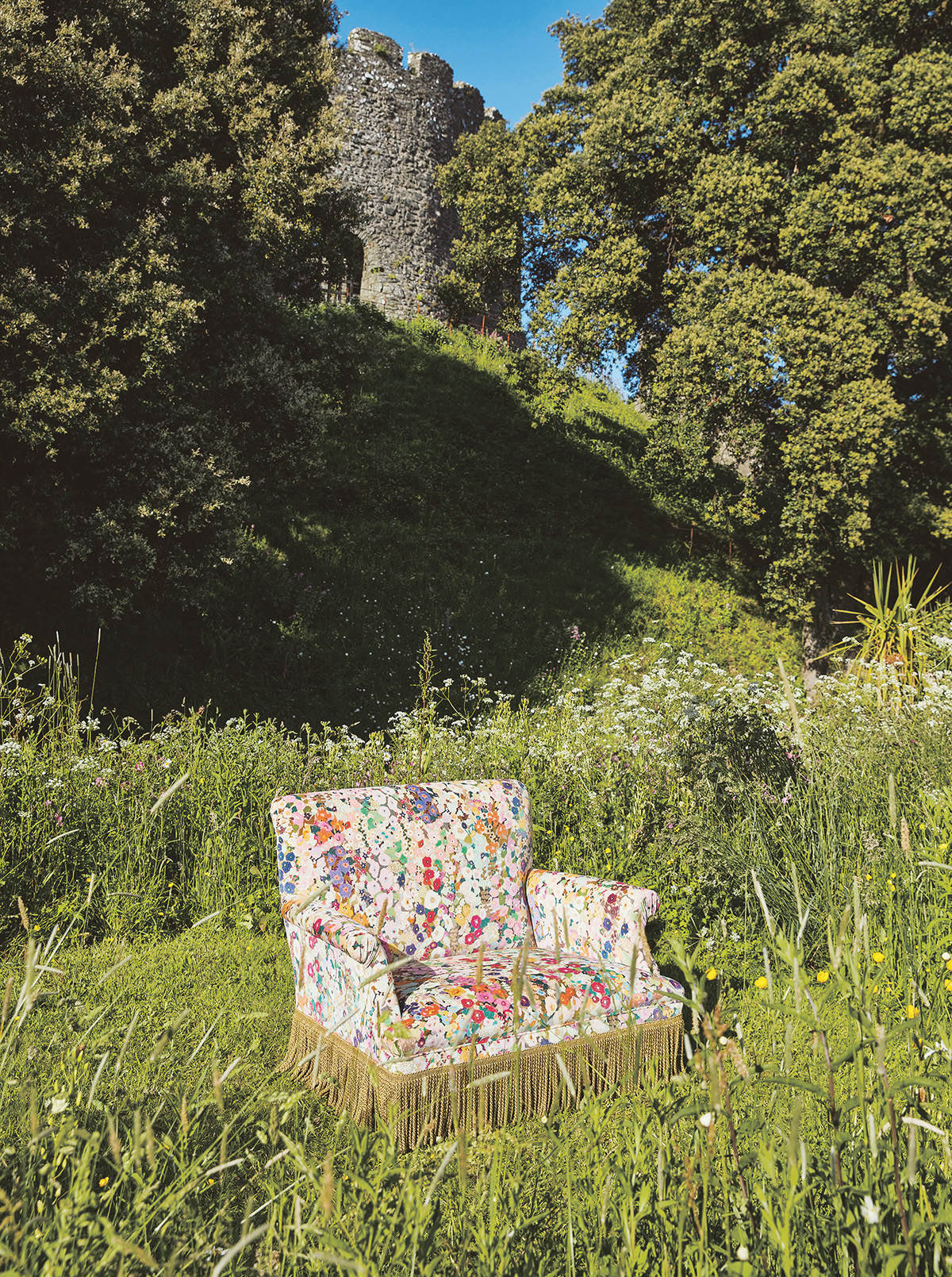
I went back to my childhood, when we were surrounded by wallpapers and textiles designed by William Morris. I wanted to create something similar and turn our home into a sanctuary of arts, crafts and Nature, but we couldn’t find the perfect products we were looking for, so we decided quite bravely to create something of our own, even without having had any background in interiors or having been schooled in business. But I suppose, with a hand- and heart-led approach to something, you can become quite positively disruptive.
In the beginning, the business was very much set up around our kitchen table. It was intentionally cottage-sized. We really wanted to create something that was small and beautiful. Our mission was almost a rebellion against the high street model. The goal was to create beautifully made products that would last, and we were very inspired by William Morris, particularly his textiles. And the more we learned about him, the more he became a big inspiration for us. We wanted to make products that were beautiful, useful and durable – products that were made to last and made with happy hands.
SK: How did you find people who were making products with happy hands?
FG: We did a little tour around the UK with our toddler son in our van, knocking on doors. We were really pleased to find that these generational factories still existed around the UK: china from Stoke-on-Trent, furniture-making companies in Loughborough, textiles in Lancashire, and so on. That was 16 years ago, and the friends we made then are still our friends. They’re very much our extended team. From the very start we were interested in craftsmanship, in quality, in our footprint on planet Earth. The waste was very, very little. We started to spend more time in Nature. We constantly observed Nature. Nature moved from being our muse to being our teacher. We started to observe the seasons and realised that Nature is a living system.
SK: And then you made Nature a partner and a board member of your company.
FG: Yes, it was the journey of transformation in consciousness, and three years ago we made Mother Nature a legal director of our company.
We felt that we couldn’t keep taking Nature for granted in our business and see Nature simply as a resource for the economy. We need to establish the right relationship with Nature. For too long, Nature has been externalised – out there, simply a resource. We felt an obligation to invite Nature’s voice into the company, so that we can really listen and make decisions around our impacts on Nature and future generations.
There is a fantastic British company called Faith in Nature, a cosmetics company that made Mother Nature a legal director of their company. They created a legal mechanism in their articles of association, and we were very inspired by that. We made a move from being, on paper, a sustainable company and a B Corp (a for-profit company verified by B Lab to meet high standards of social and environmental performance, accountability and transparency) to a business that considers Nature our true business partner. For us, the idea of just sustaining the status quo wasn’t enough. We really felt we had a duty to move beyond sustaining and offsetting, to actively becoming a force for restoration. Hence we wrote that into our articles of association. Now Nature as a director is embodied in a person who sits on our board and represents Nature.
We invite Nature into our day-to-day decision-making, so our team of about 50 people very much have a litmus test in their decision-making. They should be able to answer the questions “Is our decision going to harm or enhance Nature?” and “What is going to be the impact of our decisions on future generations?”
SK: This is wonderful! Now I want to ask you what you think of circular economy versus linear economy.
FG: That’s a good question. We are developing and working with the paper industry, and instead of cutting trees down we convert plant waste into paper. When our wallpaper is put on a wall, it should stay there for a long time. So for us it’s about the protection of Nature. We work with the World Land Trust, so 1% of all our sales goes towards Nature restoration. We don’t want to be cutting down any trees for our wallpaper. With our cotton, we’ve just piloted our first regenerative cotton crop for interior products. We’ve moved from conventional to organic and regenerative cotton, using the principles of regenerative farming.
SK: You want to influence the business world with your book. How do you see business becoming more Nature-friendly? You have used in your book the phrase, “Nature is not a commodity, Nature is a community.” How do you see that the business world can adopt this idea?
FG: I really believe that real change can happen at grassroots level. And the most significant change happens in the periphery. The change can gather pace from there. The B Corp movement is a movement that we’re very proud of, and there is a resurgence of small and medium-sized businesses taking the lead. That is where my hopes are.
We need to move beyond sustainability to regeneration. Businesses should actively restore Nature and give back more than they take. We need to shift our focus from short-term growth, unlimited economic growth and shareholder primacy to long-term sustainability and regeneration. We need to move towards multi-capital: natural capital, human capital and creative capital.
We’ve been measuring the true cost of a product, beyond the price that we pay when we buy a product from our suppliers. We want to find out the ecological and societal cost of that product. From there we can move from a degenerative to a regenerative economy. Nature needs to be there on the balance sheet. It’s so sad to think that a forest is worth more as wood than as a living forest.
SK: In your company your staff are working fewer hours and having more time for themselves. Is that so?
FG: Yes, we really believe in human creativity, in the workplace being enjoyable, and in the flourishing of people within it. We need to remember the fact that we are biological beings. We are Nature, and we need to be in Nature. We are working in the post-industrial age where more free time was promised to us. But we were never given the time that was promised. Therefore our company is a pioneer of the four-day week. We call it ‘Nature Fridays’, and it’s part of our Time with Nature Policy. We encourage the members of our team to have meetings outside in Nature and have walking meetings. We are lucky to have a little garden where we work, so we really encourage everyone to use the garden for meetings. Our team members have every Friday off, which is paid as normal, with the invitation to spend time in Nature, whatever that means for them.
SK: So how do you see House of Hackney in the next 20 years?
FG: I don’t think it’s about growth for growth’s sake. We are an incubator brand. What we would love to prove is that you can be a financially and holistically successful company without damaging Nature. We are a force for Nature restoration. We are moving from a blueprint to a greenprint model of business. We want other businesses to follow the greenprint we’re working on. So the next phase of our business is to present an example of greenprint. We would like, in a humble manner, to offer a way forward and show how to make a business Nature-friendly.
SK: What’s the difference between a blueprint and a greenprint?
FG: Well, the greenprint shows that Nature has a seat at the table. It will cover governance, culture, the idea of Nature licensing and Nature-friendly profit-and-loss. Once we’ve drafted the greenprint paper, we hope that it becomes a working document. We are aiming for something that’s very objective, practical and useful for other businesses to adopt. Hopefully this will give others confidence in moving from blueprint to greenprint.
The purpose of this greenprint model that we are incubating is to make a business financially healthy and at the same time look after the wellbeing of both people and planet simultaneously. That, for me, is success.
You can read more about House of Hackney’s impact at www.houseofhackney.com/pages/our-impact