Donate


It’s not unheard of for artists never to see their work complete. Musician Jeff Buckley never got his hands on a copy of Sketches for My Sweetheart the Drunk, polymath Leonardo da Vinci never saw ‘Adoration of the Magi’ completed, nor architect Jørn Utzon his Sydney Opera House. But it’s not always untimely death, distraction, or dispute that causes a disconnect. Artist Luke Jerram has long known that his project will take more years to evolve than – it’s safe to say – he has left on the planet. That’s because his is a sculpture of trees that will take a century to develop.
Described as a living Stonehenge, the artwork known as Echo Wood, located near the villages of Hunstrete and Compton Dando in Somerset, England, currently consists of 365 saplings destined to grow into a perfectly circular woodland. From its hawthorn circumference, pathways geometrically swirl inwards – from the air appearing like an ammonite fossil – towards a clearing of statuesque oak. Its trees are precisely geolocated, and with seasonal shades of green, pink and red as delicately balanced as a painting, Echo Wood may be the cre-ative focal point, but it’s the interplay with the forest encasing it that packs the punch environmentally.
If Echo Wood is a nucleus, its cell is the Lower Chew Forest – a landscape roughly 265 football pitches in extent, currently in transition from its former life as farmland. What’s taking shape here is thanks to Avon Needs Trees, a local charity that buys land to create new, permanent woodland across the Bristol Avon catchment.
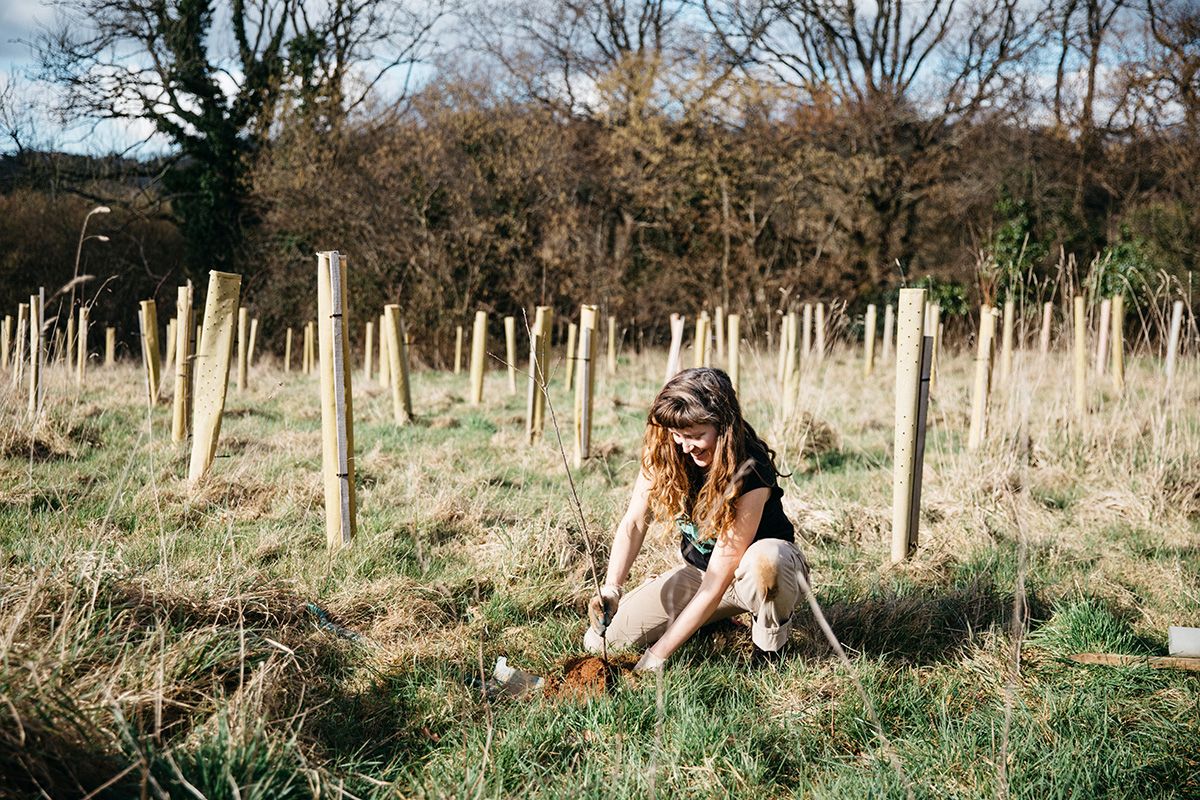
Avon Needs Trees, which began to bud following a conversation around a pub table in 2019, is young but already accomplished, having done much of its groundwork to date at Great Avon Wood, a project a couple of miles away near Pensford – 113 acres of woodland developed in partnership with the Forest of Avon Trust and the Woodland Trust. Yet back here at Lower Chew Forest, what sets the landscape apart most is the ambitious speed and scale of the planting process: 70,000 trees dug into the ground between November 2025 and April 2026. Why the rush?
“Move fast and grow things,” offers Avon Needs Trees’ communications and engagement lead, Alex Turner, as the charity’s unofficial maxim. “It’s a way to keep in step with the urgency of the climate crisis while moving only as fast as due diligence allows. It’s not a numbers game though, not a spamming of trees. It’s all about the right number of the right trees in the right places – future-proof and climate-adapted.”
Alongside its use of native species – such as crab apple, bird cherry, dogwood and field maple – chosen for their ability to thrive and endure, Avon Needs Trees places biodiversity at the heart of its reforestation strategy. Lower Chew Forest is set to be a mosaic of habitats, including wetland, wild-flower meadows, hedgerow and orchard, alongside areas of natural regeneration. The conditions created are projected to deliver a 246% increase in wildlife habitat value by 2030.
“When we saw the land come up in 2023, we quickly realised that it was somewhere we had an opportunity to do something quite impactful,” says Turner, referencing the overwhelmingly positive implications identified for flood management and carbon capture in one of England’s most forest-depleted regions. “The Environment Agency advised us to grab it with both hands”. A meeting of minds ensued, with the artist soon in touch to discuss a potential collaboration.
Jerram’s proposal, met with a ‘yes’, was to conceive a further dimension for Lower Chew Forest – a cultural strategy that could turn heads at a time when the planet needs them to turn.
“Many of my works communicate ideas about, and raise awareness of, environmental issues,” says Jerram, “whereas Echo Wood is physically doing something about it. I’m collaborating more with environmental charities these days to help them with their objectives. Echo Wood is an example of that.”
It’s not the first time the artist has invited the public to interact meaningfully with his work. His aim is to encourage people beyond passive admiration towards active engagement. You may well have experienced his work before, though without knowing his name. Past projects including ‘Play Me, I’m Yours’ street pianos, giant sculptures of the Earth, sun and moon suspended at venues worldwide, and, most adrenaline-inducing of all, ‘Park and Slide’, a giant waterslide installed on Bristol’s hilly Park Street for one day in 2014.
As to how the public will engage with the current work, the vision is that Echo Wood’s clearing will become a place of gathering and community for generations to come – “for educational activities, for weddings and for musical events,” says Jerram. There will also be 5km of permissive paths to walk.
As part of the woodland management process, ancient techniques such as pollarding and coppicing will be used to extend the life of the trees, with the removed wood used for educational and creative projects. Over time, as the trees age, mature and eventually reach the end of their lives, plans are in place for replanting, allowing the cycle of growth and renewal to continue.
But that’s all in the future. Right now, the humans at the centre of this story are the charity’s team of 26, charged with all manner of operations, from communicating with nearby residents – this is a significant change to the local landscape, after all – to working on new areas of growth such as the Landscape Recovery project, which channels post-Brexit subsidies to local farmers for habitat restoration at a landscape scale.
Equally central are the growing number of people coming forward to sponsor a tree – “We can’t wait to see you blossom,” reads one sponsor’s touching dedication to a godchild) – as well as, crucially, a remarkable amount of volunteer graft: from heeling in to providing whips with mulch mats, stakes and tree guards, as well as longer-term care and conservation.
Lower Chew Forest – and Echo Wood at its heart – is something that is really capturing people’s imaginations, affirms Turner, a “message of hope that we’re passing to future generations. It’s something to show them that we were concerned about the environment – that people made positive marks on the landscape as well as negative ones.” A holding of hands between generations, if you like.
Echo Wood is already accessible via existing public footpaths and rights of way. Further woodland trails are planned, alongside volunteer days and community events, with details available via the Avon Needs Trees website and newsletter. www.avonneedstrees.org.uk