Donate


“What does it mean to own land?” asks Nadia Shaikh, a co-director of the Right to Roam campaign and one of the key narrators in new documentary Our Land. For her, this question is rooted in themes of belonging and control, and the fact that 92% of the English countryside is inaccessible to the general public – a statistic that she and other campaigners are trying to change. Grierson-shortlisted filmmaker Orban Wallace is interested in these themes too.
The film begins with a brief animated introduction written by Robert Macfarlane, the author of Is a River Alive?, foregrounding the history of the land justice debate in the United Kingdom. Through this sequence, we visualise how the enclosure system after the Norman Conquest both carved up land in England and contributed to class systems by concentrating land ownership into the hands of a few elites. This has only become more entrenched over time, as Wallace shows us, through the construction of estates and grand houses built on the wealth accrued from colonial exploitation.
We are then transported from the past into the present day. Wallace shows us there is no clear dividing line between the two. A dispute over wild camping on Dartmoor in Devon is a key catalyst, with campaigners gathered in their thousands in a colourful, joyful and noisy protest in 2023. Dartmoor was well known as the only place in England where wild camping was allowed without the permission of landowners, and the protest was in response to a recent high court ruling in which landowners had won the right to remove campers. Following tireless efforts by campaigners, a supreme court ruling in 2025 ultimately declared that the public has the legal right to camp on the land.
Wallace constructs a conscious contrast between the landowners and the campaigners. Classical string music swells as estate owners are interviewed in their homes, framed by grandiose portraits of their ancestors. One estate owner is even warned by a relative that participating in the film will make him look like “an upper-class twit”. Yet Wallace’s non-confrontational technique lets these interviewees speak for themselves, rather than explicitly demonising or ensnaring them.
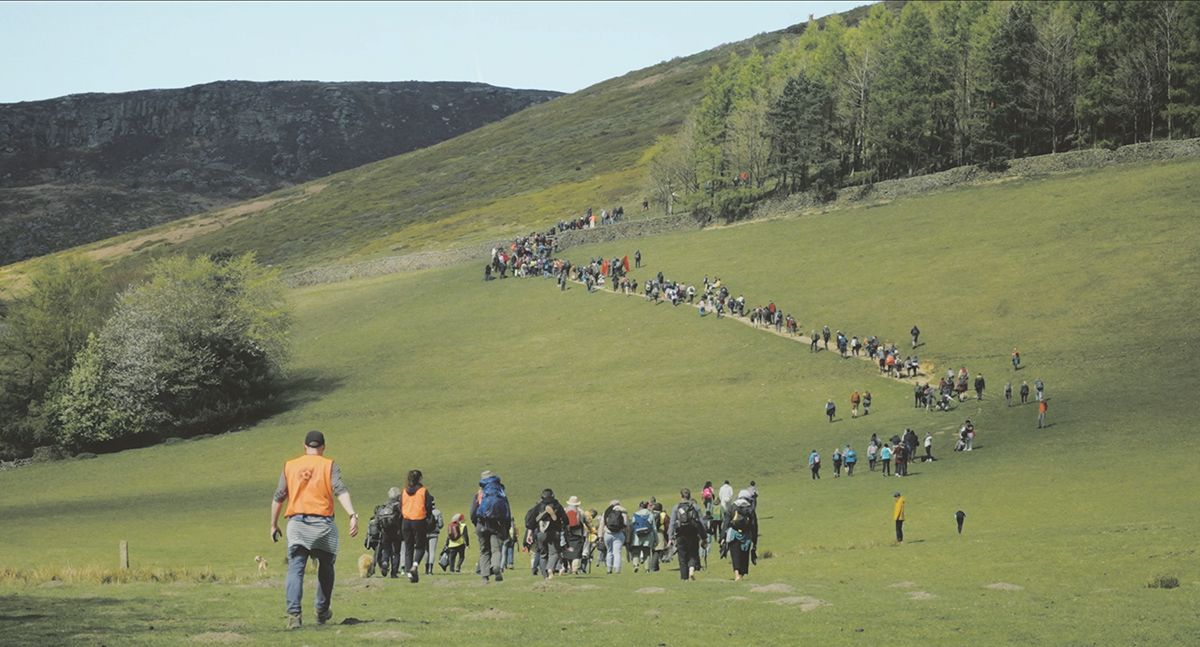
Campaigners, by contrast, are often interviewed on the move, as part of groups, as well as close up in their own living spaces. Shaikh is seen both in her kitchen preparing for a Right to Roam gathering, and leading a group observing a symphony of birdsong while trespassing – a term framed positively by campaigners in the film. The emotional connection between those trespassing for the first time and the environment they’re experiencing is palpable, particularly in a moving sequence of a landmark walk in the Peak District in 2022 showing people of colour at home in an environment that some have historically felt isolated from.
The film’s strength lies in its third act, which looks at solutions. In Scotland, where public access to land has been established since 2003 through the Land Reform (Scotland) Act, Wallace shows us that more equitable forms of land management are not just possible, but already well established.
I watched the documentary on a train journey from Leeds to London, where expansive fields of green crops and yellow rapeseed were illuminated in the late-afternoon light. Looking out of the windows on both sides, I wondered who might own the lands surrounding the train tracks, and whether such places had been explored or appreciated beyond the confines of my carriage.
The central question Our Land seeks to untangle is connected to its title: whose is the ‘our’? For some estate owners, the answer appears to be an individualistic view, rooted in the idea that land is inherited and therefore requires control. For campaigners, both enjoyment of and responsibility for the land must be shared. Ultimately the film’s framing moves away from an ‘us vs. them’ binary, and more towards an interrogation of systems and structures that could enable greater education about, access to and connection with our shared land.
Our Land (2025) by Orban Wallace (director) is in UK cinemas now. www.ourlanddocumentary.com