Donate


Peter Carr is a retired prawn fisherman who lives on the shore of Loch Hourn, on the west coast of Scotland, near the island of Skye. The John Muir Trust describes the area as “one of the wildest and most beautiful parts of Scotland”. Peter moved here about 50 years ago.
“In the first year I picked winkles,” he tells me. “Then I bought a compressor and started diving for scallops. It was phenomenal. It was just dolphins, whales. You just could not believe the wildlife here. The undamaged seabed was like a wild garden.”
Today, there is trouble in this paradise. Peter has witnessed successive waves of fishermen arriving and emptying the loch of its wildlife. The herring were the first species to be overfished. The bonfire of regulations in the 1980s had removed rules keeping trawler boats out of the loch. Then came the bottom trawlers.
This was one of the many consequences of the rise of neoliberalism as the prevailing economic paradigm in the last half-century. The unregulated market has its own logic and will meet people’s needs while finding a natural equilibrium. Yet the rolling back of regulations at Loch Hourn has meant the wild fish populations are now seriously depleted. Climate breakdown, from unregulated carbon emissions, is also having an impact. The fish have moved to cooler waters in the north, towards Norway.
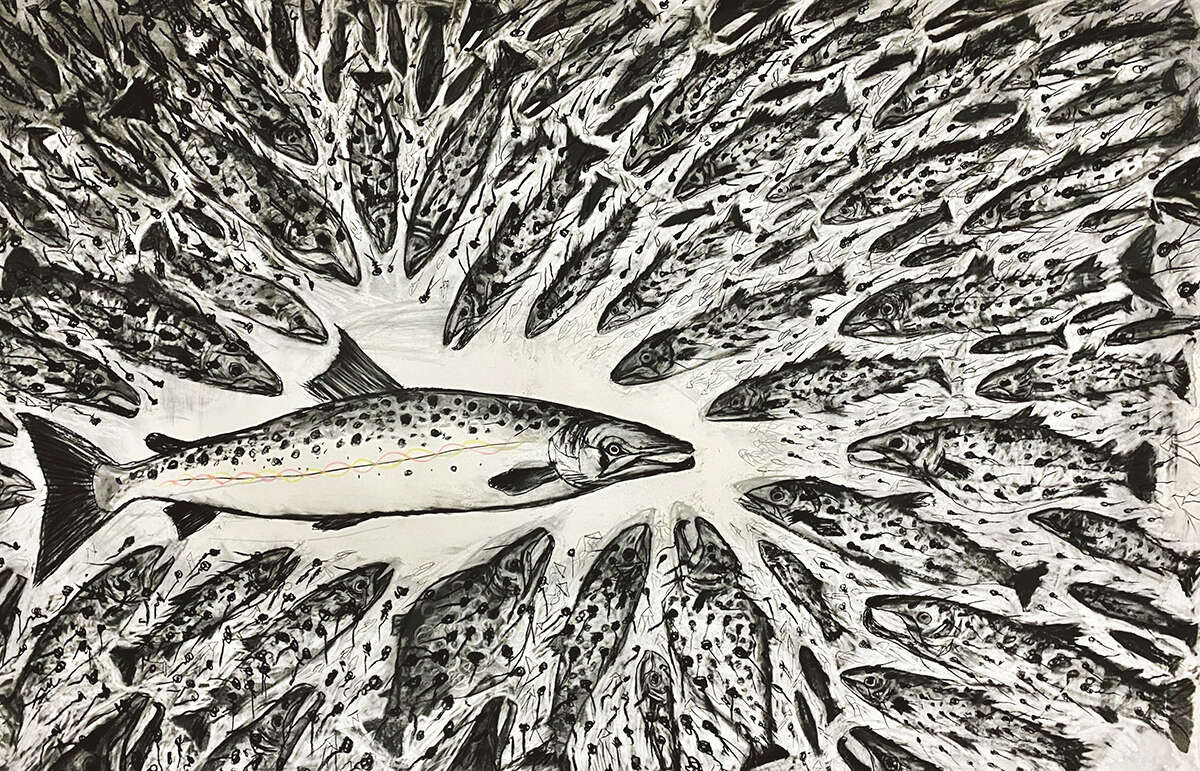
Today, Peter is concerned about the expanding Atlantic salmon farms in the loch. He and other residents set up Friends of Loch Hourn to campaign against a planning application submitted by Mowi Scotland (the UK’s largest supplier of farm-raised salmon) to increase the size of its operations here.
Intensive salmon farming has resulted in outbreaks of sea lice, and the release of excess nutrients, pesticides and fish waste into the loch. Despite all this, the planning appeals reporter appointed by the Scottish government ruled in favour of Mowi expanding its operations.
Rachel Mulrenan, Scotland director at WildFish, says: “Open-net salmon farming is one of the key threats facing our iconic wild Atlantic salmon populations.” Ailsa McLellan, an oyster farmer and campaigner, adds: “It is so difficult for communities to fight salmon farms, it’s always a ‘David versus Goliath’ battle.”
An extractive industry
The city of Bergen is nestled where the mountains meet the fjords, opposite the island of Litlesotra on the west coast of Norway. It is an international centre for aquaculture. Mowi is headquartered here.
Mowi farms produced 502,000 tonnes of fish in 2024 and made €860 million in operating profits. The campaign groups Feedback Global and The Global Salmon Farming Resistance (GSFR) published a new report, Fishy Finances. It states that Mowi was the largest recipient of credit extended to the industry from global financiers, receiving US$7 billion between January 2015 and November 2024, with one-third of the credit awarded to salmon farming companies.
Natasha Hurley of Feedback Global warns: “For years global financiers have helped fuel the stratospheric growth of this destructive, extractive industry while using their power and influence to push misinformation about salmon farming. This cannot go on – it’s time to listen to local communities and stop the financing of industrial salmon farming.”
The Norwegian government recently introduced a special 25% tax on salmon production, and the country came close to banning intensive salmon farming, acknowledging that wild North Atlantic salmon populations are facing an existential threat. Andreas Bjelland Eriksen, the climate and environment minister, said at the time: “The impact from everything that we do is becoming more than Nature, our stocks, can actually handle.”
Mowi can avoid some of the new tax and the risk of a ban by expanding its operations in Scotland. The British and Scottish governments are both pouring taxpayer money into the industry. Mowi, for example, received a £7 million grant through the UK Seafood Fund.
Hurley adds: “It’s truly shocking that public money is being given to wealthy salmon farming corporations whose shareholders are netting big profits at the expense of wild fish populations and communities around the world.”
Playing the harvest game
The city of Vienna is the birthplace of Friedrich Hayek, the father of neoliberal economics. I travelled there by train to take part in the Alternative Economic and Monetary Systems summer university programme.
Helga Kromp-Kolb, Austria’s best-known climate researcher, spoke with kind authority. She was introducing an audience of 50 students to the harvest game, taken from The Climate Change Playbook by Dennis Meadows et al.
The game is simple. We students formed five groups of six people, each representing a fishing village. There were at most 50 fish in the ocean, but no rules limiting the number of fish each of the villages could take. The fish that remained would double each season.
Some in our group wanted to make sure we did not deplete the stock, but others were focused on getting more fish than ‘rival’ villages, and on “winning the game”. We found ourselves deep in heated discussions about trust, belonging and community. One student, who had recognised the relationship of dwindling fish populations to the climate crisis, was overwhelmed with frustration.
The game made real for us a decades-old debate between two academics about how we should manage shared resources. Garrett Hardin, an ecologist with an interest in game theory, published ‘The Tragedy of the Commons’ in 1968. He speculated that if each fisherman maximised their profit from a shared resource, they would inevitably take more than Nature could restore. The ‘commons’ would be destroyed. You should never be “shamed into standing aside” while “the rest of us exploit the commons,” he warned.
Elinor Ostrom definitively challenged the Hardinian nightmare in her book Governing the Commons: The Evolution of Institutions for Collective Action. She conducted real-world field studies in Spain, Switzerland, Nepal, Japan, Indonesia. She gathered evidence of people in small communities who were successfully managing shared resources like pastures, fishing waters and forests. She helped lobster catchers in the United States work together. Ostrom found that people do take care of each other and the resources on which they collectively depend.
My Vienna circle solved these very problems, in part because of an awareness of Ostrom’s work. We brought the small villages together into one central council. We agreed to disclose the number of fish we would catch. We pooled our resources and focused only on our combined total. We were one. But, for our fisherman, Peter Carr, the consequences of overfishing are not a game. And the solution is not so readily at hand.
A spokesperson for Mowi Scotland simply said its activities at Loch Hourn were not causing environmental harm. The Friends of Loch Hourn have lost too much. But what they have gained from this fight is a sense of community and solidarity. “I didn’t really know anyone in the village,” Rick Rohde, another member, said: “This has united the community.”
Brendan attended the Alternative Economics and Monetary Systems (AEMS) summer university programme in Vienna. Details of the programme.
Brendan’s trip to Loch Hourn during 2024 was part of a press trip organised by the Highlands and Islands Environment Foundation and The European Nature Trust.