Donate


First I want to welcome you to this issue, as I have also been welcomed to the Resurgence Trust and into the role of editor. I write I, but perhaps I should say we, tipping my hat to Giuliana Furci’s fungal-inspired suggestion of pluralising pronouns, while also alluding to the ancestors who brought me us here, and the various beings – internal and external – we rely on.
Before I began this editorial role, Satish Kumar suggested that, as the magazine turns 60 this year, this issue might project forward 60 years into the future. When the first issue of Resurgence appeared in 1966, the world was changing fast, both materially and psychologically. Modernity had reached its full expression, and people were asking questions. Civil rights movements were in full swing, challenging racism, patriarchy and inherited hierarchies. The escalation of the war in Vietnam was catalysing widespread protest and a growing moral unease about militarism, empire and authority. The cold war had shifted attention to the space race, nuclear power was expanding, automation was reshaping factories and working lives, television was becoming a dominant cultural force, and plastics, synthetic fertilisers and pesticides promised convenience and abundance.
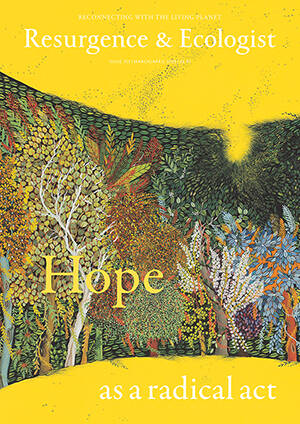
Resurgence emerged as a challenge to modernity, and as a response to the counterculture that was taking shape, calling for peace, spirituality and ecological awareness. Sixty years on, while there has been significant progress, we find ourselves at a moment when powerful interests are seemingly seeking to return us to those heady days of the 1960s. To project forward, we first have to look clearly at the now: a time of ecological collapse ignored by fossil-fuel money; a time of invasion, war and genocide; a time of technologies dependent on relentless extraction; and a time of massive and widening inequality. In Issue 354, Jane Goodall reminded us not to lose hope if we wish to save what is still beautiful in this world. But where can we look for hope today, and how radical an act is hope itself? The themed section of this issue offers four responses to those questions.
Rebecca Solnit grounds hope historically and politically, reframing it as agency, continuity and incremental change, alongside a refusal to surrender. While governments and policy fail us, The Land Gardeners return hope to the soil, focusing on the local and practical actions of farmers and growers who are building their own regenerative solutions. Giuliana Furci finds hope in the fungal world, explaining how a fungal lens reveals interdependence, cooperation and forms of intelligence that challenge human exceptionalism. And Sonji Shah questions and troubles hope itself, shifting it away from certainty towards relationship, responsibility and the not-yet-known. As we rehearse for the future, hope emerges as collective, grounded and deeply relational. It becomes a radical act, unshackled from optimism and outcomes, yet committed to participation, care and the unfinished work of imagining the otherwise.
Elsewhere in the magazine, Katie Hodgetts suggests that inner development must accompany our calls for justice, while Rachel Fleming invites us to recover more subtle ways of listening and relating to land. Amy Warren explores the idea of the evolved nest as a more nurturing relationship with our own human ecology, while Satish Kumar reflects on poetry and love as daily practices that soften the ego and widen our capacity for care. Of course there is more, much more, but we’ve run out of space here. Let us hope we haven’t run out of time – chronos, and also kairos, as Giuliana suggests.