Donate


Hope as a radical act
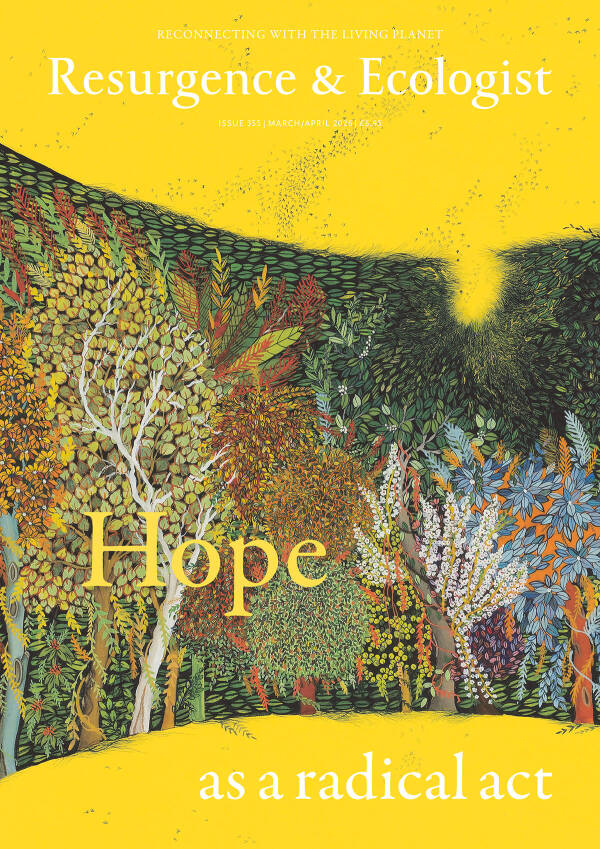
When the first issue of Resurgence appeared in 1966, the world was changing fast, both materially and psychologically. Modernity had reached its full expression, and people were asking questions.
Resurgence emerged as a challenge to modernity, calling for peace, spirituality and ecological awareness. Sixty years on, we find ourselves at a moment when powerful interests are seeking to return us to those heady days of the 1960s. To project forward, we first have to look clearly at the now: a time of ecological collapse; war and genocide; technologies dependent on relentless extraction; and massive inequality. If we wish to save what is still beautiful in this world, we must not lose hope. But where can we look for hope today, and how radical an act is hope itself? The themed section of this issue offers four responses to those questions.
Rebecca Solnit grounds hope historically and politically, reframing it as agency, continuity and incremental change, alongside a refusal to surrender. While governments and policy fail us, The Land Gardeners return hope to the soil, focusing on the local and practical actions of farmers and growers who are building their own regenerative solutions. Giuliana Furci finds hope in the fungal world, explaining how a fungal lens reveals interdependence, cooperation and forms of intelligence that challenge human exceptionalism. And Sonji Shah questions and troubles hope itself, shifting it away from certainty towards relationship, responsibility and the not-yet-known. As we rehearse for the future, hope emerges as collective, grounded and deeply relational. It becomes a radical act, unshackled from optimism and outcomes, yet committed to participation, care and the unfinished work of imagining the otherwise.
Elsewhere in the magazine, Katie Hodgetts suggests that inner development must accompany our calls for justice, while Rachel Fleming invites us to recover more subtle ways of listening and relating to land. Amy Warren explores the idea of the evolved nest as a more nurturing relationship with our own human ecology, while Satish Kumar reflects on poetry and love as daily practices that soften the ego and widen our capacity for care. Of course there is more, much more. Let us hope we haven’t run out of time – chronos, and also kairos.
Free to read
Featured articles
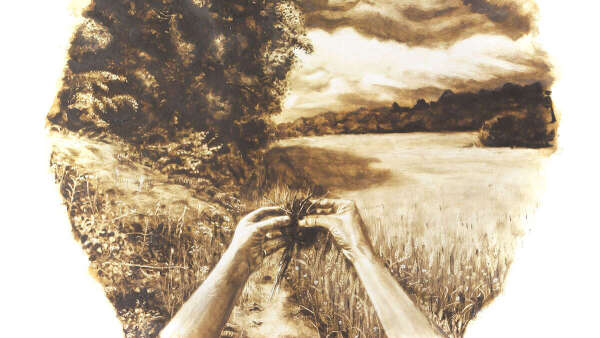
The radical hope of soil
Bridget Elworthy and Henrietta Courtauld trace a worldwide network of communities healing soil and reweaving relationships between people and land. We all have a role in making change – through the choices we make and the producers we support.
Read more...

Agreements that bind us
Taking key findings from the ‘Oil in the wheels of justice’ report, Brendan Montague examines how secrecy in Britain’s trade policy continues to favour fossil fuels over Earth’s wellbeing. Caroline Lucas concludes, “UK trade policy remains cloaked in secrecy.”
Read more...
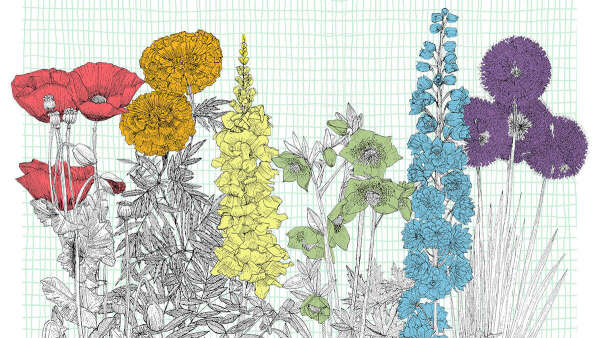
From bleak streets to greener streets
With flower-filled tree pits and streets alive with pollinators, a grassroots movement is reshaping everyday urban life. Andrea Perry reflects on how Green Streets are restoring biodiversity and connection in Croydon.
Read more...
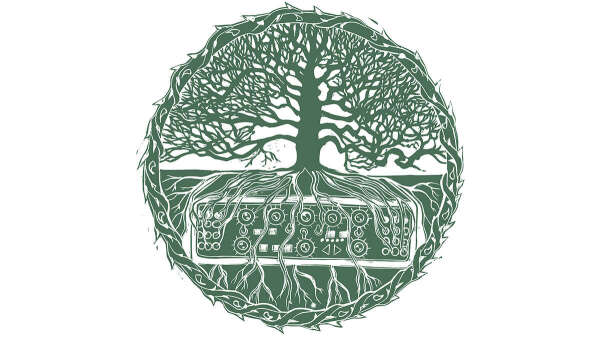
The sounds of the deep below
Rowena Wilson discusses music, plants and mindfulness with environmental artist, musician and plant advocate Alex H Duncan, whose calling is to “give plants a voice in a world so desperately in need of their undoubtable wisdom.”
Read more...
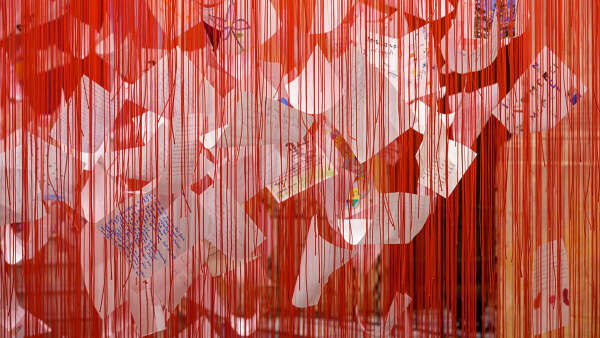
Threads of life
Artist Chiharu Shiota’s reflects on her new exhibition that speaks of our interconnectedness, shared memory and common humanity. “Through my work, I try to make sense of life and its uncertainties. As each installation has grown from personal experiences such as loss, death and relationships, I want to expand these feelings into something universal.”
Read more...
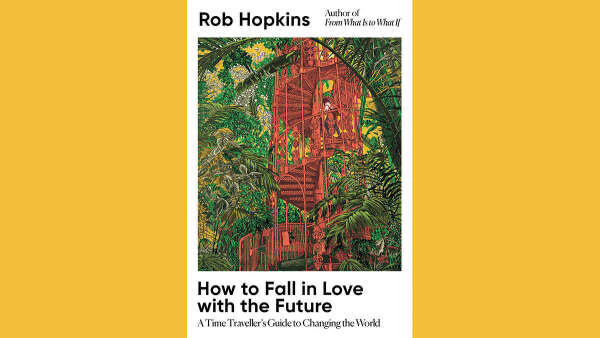
Idealised dream or powerful tool?
India Bourke reviews How to Fall in Love with the Future: A Time Traveller’s Guide to Changing the World by Rob Hopkins – a compelling guide to imagining a future we would want to live in.
Read more...
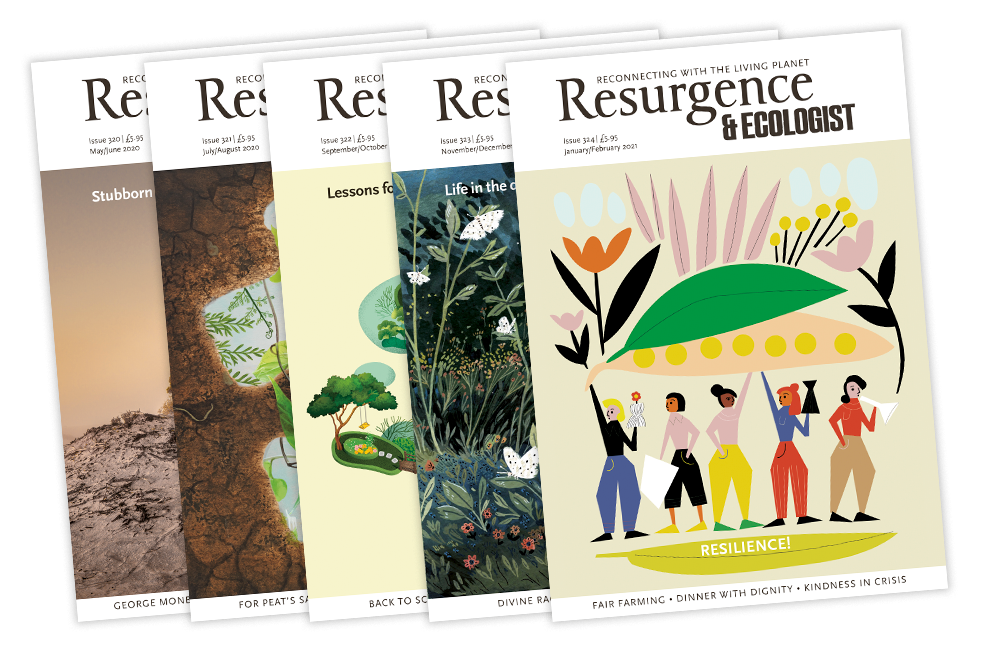
Membership Includes:
6 issues of Resurgence & Ecologist magazine a year
Access to:
• Articles online • Digital Editions • Archive issues
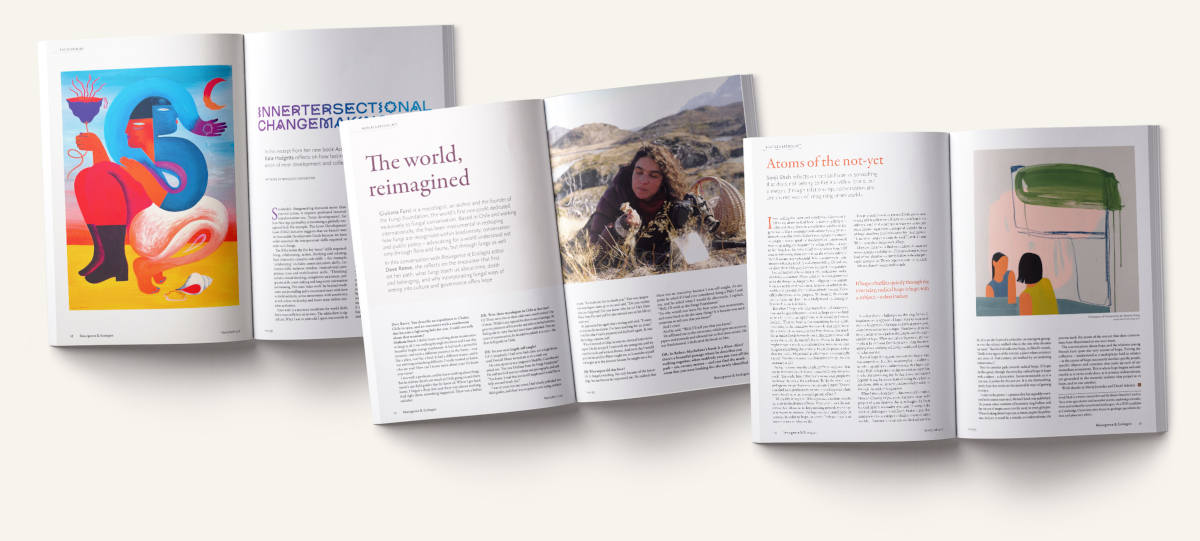
Inside this issue
Article is free for all to view
Welcome
Imagining the otherwise • Dave Reeve
Where can we look for hope today?
Regulars
Noticeboard
Highlighting stories for change
Hope as a radical act
Refusing to give up on hope • Suyin Haynes
An interview with Rebecca Solnit about hope, incremental change and the emergence of a new world
The radical hope of soil • Bridget Elworthy & Henrietta Courtauld
Tracing global communities renewing relationships with the land
The world, reimagined • Dave Reeve
Talking with Giuliana Furci about funga, belonging, and new ways of knowing
Atoms of the not-yet • Sonji Shah
Reflections on radical hope emerging through relationship, conversation and shared imagining
The slow read
Innertersectional changemaking • Katie Hodgetts
How lasting change requires inner growth and collective justice
Ecologist
Agreements that bind us • Brendan Montague
Examining how secrecy in Britain's trade policy prioritises fossil fuel over Earth's wellbeing
What next for the climate movement? • Jan Goodey
Climate action must be rooted in community, justice and collective care
Connected life
The land of nature and spirit • Andrew McAulay
Celebrating seventy years of stewardship and the influence of Kwun Yum Shan
Source • Chitra Merchant
Reflecting on soil as source
Forces and flows • Rachel Fleming
Exploring how engaging with the land's subtle intelligence restores balance, harmony and connection
From bleak streets to greener streets • Andrea Perry
Advice on making our streets greener and more biodiverse
Wisdom and wellbeing
The evolved nest • Amy Warren
Reflecting on human wellbeing and how restoring our ecological conditions can heal Earth and ourselves
Love is sovereign • Satish Kumar
Practising love and connection through daily poetry
The sounds of the deep below • Rowena Wilson
Exploring music, plants and mindfulness with musician Alex H Duncan
Art and culture
Witnessing the abyss: art, climate and the Bravo Crater • Veronica Simpson
Exploring the exhibition Kõmij Mour Ijin/Our Life Is Here and what it reveals about the Marshall Islands' nuclear and climate legacy
Threads of life • Chiharu Shiota
A new exhibition that reflects on interconnectedness, shared memory, and our common humanity
The English Oak: A seven-year love affair • Katerina Knight
Exploring how Epha J. Roe uses photography and sculpture to challenge perceptions of the vegetal world
Writing lichen • Rachel Marsh & Briony Hughes
Celebrating symbiosis and playful metaphor in Clare Goulet's poetry
Reviews
Rerouting to find meaning • Elizabeth Wainwright
Review of Against the Machine: On the Unmaking of Humanity
Collective determination • Edward Davey
Review of Sink or Swim: How the World Needs to Adapt to a Changing Climate
Idealised dream or powerful tool? • India Bourke
Review of How to Fall in Love with the Future: A Time Traveller’s Guide to Changing the World
Writing from the frontline • Adam Weymouth
Review of Life on a Little-Known Planet: Dispatches from a Changing World
Systems of compassion • Diyora Shadijanova
Review of We Grow the World Together: Parenting Toward Abolition
Building economy and ecology • Russell Warfield
Review of Radical Abundance: How to Win a Green, Democratic Future
Sold at what cost? • Mark Cocker
Review of Earth Capital: The Long History of Capitalism and Its Aftermath
Web Exclusives
Review - Timeless wisdom • Ben Lowings
Review of The Young Green Consumer Guide and Small Is Beautiful