Donate


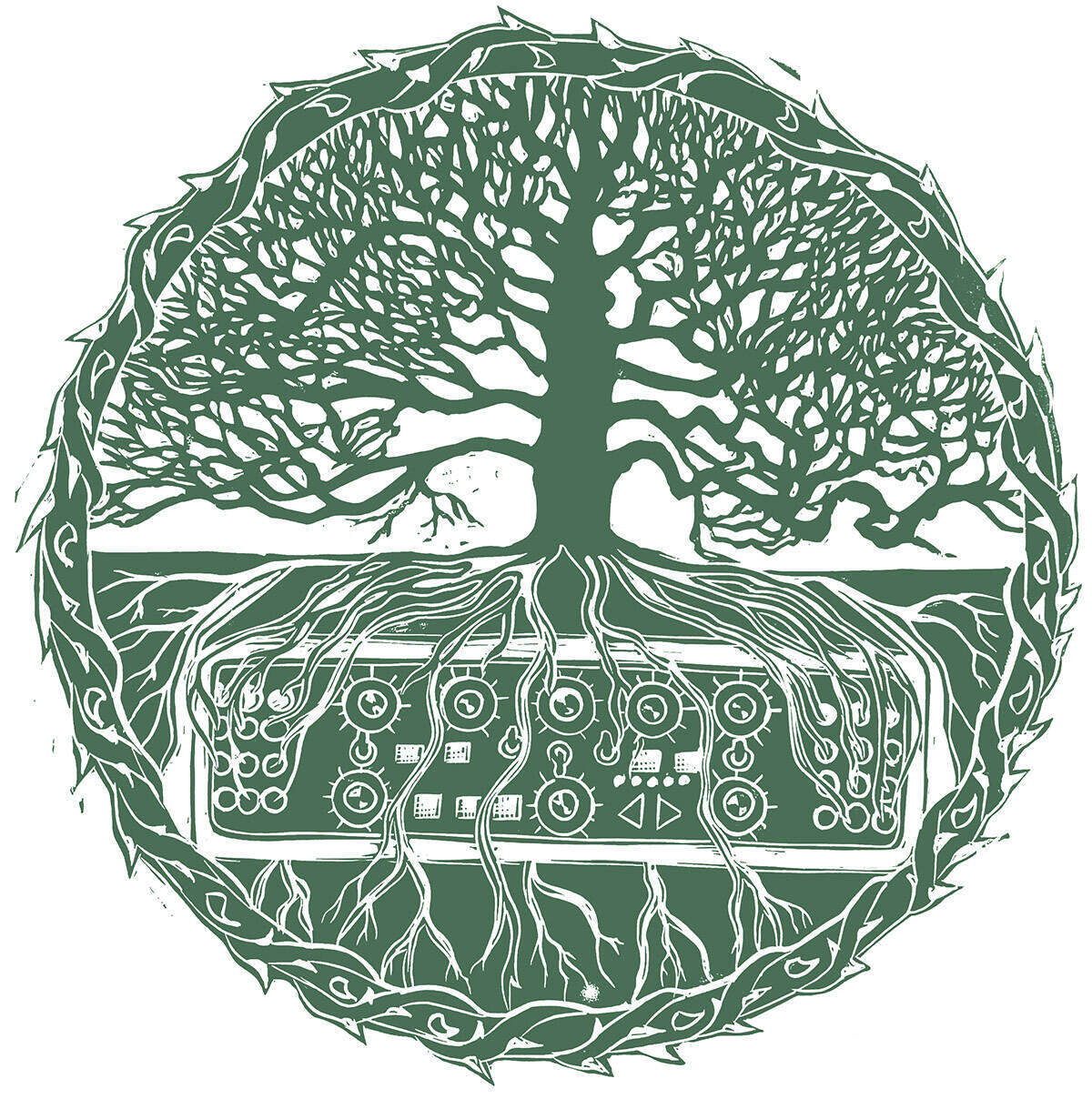
Environmental artist, musician, teacher and plant advocate Alex H Duncan is a volcano of enthusiasm and flowing energy who sees it as his calling to give plants a voice in a world so desperately in need of their undoubtable wisdom. It’s that wisdom that draws me in too. It’s clear we have both noticed how mindfulness has been playing a growing part in our creative process, and Alex is definitely the person to talk to.
“The patterns, cadences and musical structures of plants fill me with awe and delight,” he says. “Deep below us, great things are happening. I hope that those listening to my music can also imagine travelling these networks, moving beneath the busyness above, deep into vast lava flows and back through time.”
Alex doesn’t alter what the plants emit. His music accurately represents their data in audio, heard through a unique musical form shaped by his technical and compositional skills. The results are endlessly fascinating and often deeply meditative. “I do not consider plants as musicians, but more as a music producer guiding me like a mentor,” he explains. “They give me a score to start with, with no rules.”
With his first album, Subcubensis, he worked exclusively with what the plants offered him. In later albums, he introduced a human creative response to those structures. With Lichon, a live collaboration with violinist and violist Anisa Arslanagic, the exchange became even more immediate. Together they respond in real time to the biodata drawn from a log or fungus that shares the stage with them in this multi-species live act. “Sometimes, after about 20 minutes, the plants even seem to ‘fit’ in with what we’re doing,” he adds. “Like you, Rowena, I also very much enjoy the process of being in the moment.”
There is a sense of openness and unpredictability to Alex’s work that feels closely aligned with mindfulness. He describes how his creativity is no longer led by his own learned processes, but by the organisms of the living world. “I became tired of my own musical structures, aware of what I was going to think of next,” he says. “I see this move away from human-led musical creation as another way of going with a flow that’s bigger than yourself.”
I had not anticipated that learning mindfulness would change my own approach to music, which has grown away from ‘protesting-against’ songs to bringing people to something more calming. Alex’s pieces are so atmospheric that it feels like you’re on a journey. Or perhaps, as in meditation, you’ve arrived somewhere else entirely and are simply experiencing it. I’ve seen Alex’s musical scores, and they are recorded using structured bars and time signatures – but the plants defy them, making them less easy to detect.
“I work tirelessly with that biodata and I will not, under any circumstances, change the F# a tree has given me to an F just to make it more musically pleasant,” he stresses. However, he is mindful of inclusion. “I want people to listen to plants and not be put off if it’s a bit too much at first. I can, and sometimes do, make it more accessible.” Ultimately, Alex hopes to take us away from the uniform, familiar patterns we’re used to, and to allow the plants to lead us into some different thinking – a looser, more relational way of being. Sometimes the mycorrhizal networks give little pulses of something that reminds Alex of monks chanting or Moroccan Sufi trance music.
A year earlier, I had mentioned to Alex that I struggled to meditate with music because, as a musician, I can’t help analysing it – noticing chord changes and modulations, or lack of them – which interferes with my experience of simply ‘being’. He agreed that it could be distracting for him too and later evolved his plant meditations in response to that conversation.
Sitting now with his ‘Oak’ meditation piece, it is refreshing to encounter something so free of the usual musical patterns. After all, you can’t be drawn to listen for a key if there isn’t one. However, while I feel that I am put into a state the plant has determined – which is amazing in itself – I’d still prefer complete silence for my own meditations, choosing to listen to Alex’s plant music, deeply, at other times.
That distinction between listening with intention and simply listening runs through Alex’s work. For him, listening is an act of deep attention. As a dyslexic person, he explains how essential music is to the way he works. “I don’t function at my best cognitively unless music is playing,” he tells me. “With it, I’m working wonderfully.” As musicians, we listen more deeply, with a different kind of focus. Mindfulness is such an integral part of being a musician: we are totally absorbed in an uncritical way, deeply appreciating the sound. He adds, “Maybe that’s why I like using music from fungus and plants because it makes my journey towards the mindful state easier – as I otherwise may be consumed by my own ego – like deciding what other people might think about it, or even whether I like it.” I likened this to the terms used by Breathworks, a mindfulness charity, of being eased from the ‘doing’ mode into the ‘being’ mode. “It’s been a journey to some sort of epiphany for me,” he explains. “It’s more authentic now and it’s changed the way I write today.”
I love the idea that living organisms determine many of Alex’s creative outcomes. His plant music feels like an inner journey. You are taken somewhere you haven’t been before. You are meeting the plant world, and it is rather beautiful. “I feel that doing meditations and creativity that’s very connected to Nature has made me feel so much more comfortable,” he says. “Like I’m more a part of it, less terrified that there is a limited time. It has changed me enormously.”
The happiness exuding from Alex and me during our conversation reflects our mutual love of creating music, the unexpected journeys it takes us along, and the never-ending source of inspiration from the natural world. ‘Happiness’ feels like exactly the right word for both of us as creators of music. Whatever your experience of listening, we hope it is stimulating and unfolds beautifully.
Alex will be taking part in an online event with Resurgence on 24 March 2026. You can find out more about his work at www.composerinthewoods.com